


Page 349 - 9780077418427.pdf
P. 349
/Users/user-f465/Desktop
tiL12214_ch13_323-350.indd Page 326 9/3/10 6:14 PM user-f465
tiL12214_ch13_323-350.indd Page 326 9/3/10 6:14 PM user-f465 /Users/user-f465/Desktop
Hydrogen-1 Hydrogen-2 Hydrogen-3 the same, and the sum of the subscripts (atomic number, or
numbers of protons) in the reactants must equal the sum of the
1p 1p 1p subscripts in the products; and (2) the total number of nucleons
0n 1n 2n remains the same, and the sum of the superscripts (atomic mass,
or number of protons plus neutrons) in the reactants must equal
3
1 1 H 1 H 1 H the sum of the superscripts in the products. The new nucleus
2
remaining after the emission of an alpha particle, therefore, has
(deuterium) (tritium) an atomic number of 90 (92 – 2 = 90). According to the table
of atomic numbers on the inside back cover of this text, this
new nucleus is thorium (Th). The mass of the thorium isotope
Mass is 238 minus 4, or 234. The emission of an alpha particle thus
number decreases the number of protons by 2 and the mass number
H by 4. From the subscripts, you can see that the total charge is
Atomic
number conserved (92 = 90 + 2). From the superscripts, you can see
that the total number of nucleons is also conserved (238 =
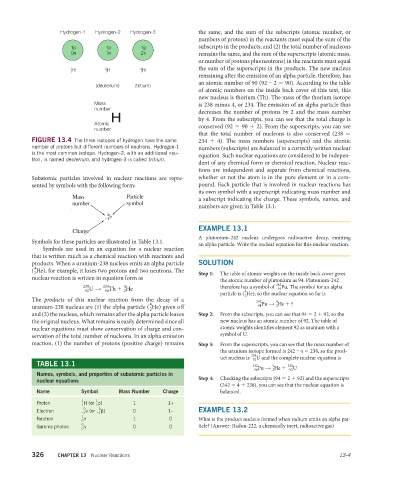
FIGURE 13.4 The three isotopes of hydrogen have the same 234 + 4). The mass numbers (superscripts) and the atomic
number of protons but different numbers of neutrons. Hydrogen-1 numbers (subscripts) are balanced in a correctly written nuclear
is the most common isotope. Hydrogen-2, with an additional neu- equation. Such nuclear equations are considered to be indepen-
tron, is named deuterium, and hydrogen-3 is called tritium.
dent of any chemical form or chemical reaction. Nuclear reac-
tions are independent and separate from chemical reactions,
Subatomic particles involved in nuclear reactions are repre- whether or not the atom is in the pure element or in a com-
sented by symbols with the following form: pound. Each particle that is involved in nuclear reactions has
its own symbol with a superscript indicating mass number and
a subscript indicating the charge. These symbols, names, and
numbers are given in Table 13.1.
EXAMPLE 13.1
A plutonium-242 nucleus undergoes radioactive decay, emitting
Symbols for these particles are illustrated in Table 13.1.
an alpha particle. Write the nuclear equation for this nuclear reaction.
Symbols are used in an equation for a nuclear reaction
that is written much as a chemical reaction with reactants and
products. When a uranium-238 nucleus emits an alpha particle SOLUTION
4
( He), for example, it loses two protons and two neutrons. The Step 1: The table of atomic weights on the inside back cover gives
2
nuclear reaction is written in equation form as
the atomic number of plutonium as 94. Plutonium-242
242
238 234 4 therefore has a symbol of Pu. The symbol for an alpha
U → Th + He 4 94
90
2
92
particle is ( He), so the nuclear equation so far is
2
The products of this nuclear reaction from the decay of a 242 4
4 Pu → He + ?
94
2
uranium-238 nucleus are (1) the alpha particle ( He) given off
2
and (2) the nucleus, which remains after the alpha particle leaves Step 2: From the subscripts, you can see that 94 = 2 + 92, so the
the original nucleus. What remains is easily determined since all new nucleus has an atomic number of 92. The table of
nuclear equations must show conservation of charge and con- atomic weights identifies element 92 as uranium with a
servation of the total number of nucleons. In an alpha emission symbol of U.
reaction, (1) the number of protons (positive charge) remains Step 3: From the superscripts, you can see that the mass number of
the uranium isotope formed is 242 – 4 = 238, so the prod-
238
uct nucleus is U and the complete nuclear equation is
92
TABLE 13.1 242 4 238
Pu → He + U
2
92
94
Names, symbols, and properties of subatomic particles in
Step 4: Checking the subscripts (94 = 2 + 92) and the superscripts
nuclear equations
(242 = 4 + 238), you can see that the nuclear equation is
Name Symbol Mass Number Charge balanced.
1 1
Proton H (or p) 1 1+
1
1
0 0
Electron e (or β) 0 1– EXAMPLE 13.2
–1
–1
1
Neutron n 1 0 What is the product nucleus formed when radium emits an alpha par-
0
0
Gamma photon γ 0 0 ticle? (Answer: Radon-222, a chemically inert, radioactive gas)
0
326 CHAPTER 13 Nuclear Reactions 13-4

