


Page 410 - 9780077418427.pdf
P. 410
/Users/user-f465/Desktop
          tiL12214_ch15_377-404.indd Page 387  9/3/10  6:17 PM user-f465
          tiL12214_ch15_377-404.indd Page 387  9/3/10  6:17 PM user-f465                                                /Users/user-f465/Desktop


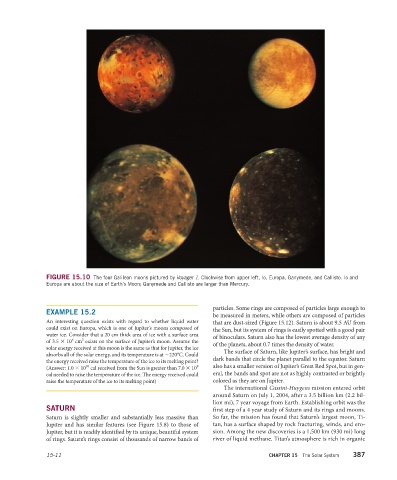
                       FIGURE 15.10  The four Galilean moons pictured by Voyager 1. Clockwise from upper left, Io, Europa, Ganymede, and Callisto. Io and
                       Europa are about the size of Earth’s Moon; Ganymede and Callisto are larger than Mercury.


                                                                               particles. Some rings are composed of particles large enough to
                       EXAMPLE 15.2
                                                                               be mea sured in meters, while others are composed of particles
                       An interesting question exists with regard to whether liquid water   that are dust-sized (Figure 15.12). Saturn is about 9.5 AU from
                       could exist on Europa, which is one of Jupiter’s moons composed of   the Sun, but its system of rings is easily spotted with a good pair
                       water ice. Consider that a 20 cm thick area of ice with a surface area   of binoculars. Saturn also has the lowest average density of any
                                   2
                                6
                       of 3.5 × 10  cm  exists on the surface of Jupiter’s moon. Assume the   of the planets, about 0.7 times the density of water.
                       solar energy received at this moon is the same as that for Jupiter, the ice
                       absorbs all of the solar energy, and its temperature is at −220°C. Could   The surface of Saturn, like Jupiter’s surface, has bright and
                       the energy received raise the temperature of the ice to its melting point?  dark bands that circle the planet parallel to the equator. Saturn
                                     10
                                                                         9
                       (Answer: 1.0 × 10  cal received from the Sun is greater than 7.0 × 10    also has a smaller version of Jupiter’s Great Red Spot, but in gen-
                       cal needed to raise the temperature of the ice. The energy received could   eral, the bands and spot are not as highly contrasted or brightly
                       raise the temperature of the ice to its melting point)      colored as they are on Jupiter.
                                                                                  The international Cassini-Huygens mission entered orbit
                                                                               around Saturn on July 1, 2004, after a 3.5 billion km (2.2 bil-
                                                                               lion mi), 7 year voyage from Earth. Establishing orbit was the
                       SATURN                                                  first step of a 4 year study of Saturn and its rings and moons.
                       Saturn is slightly smaller and  substantially less massive than   So far, the mission has found that Saturn’s largest moon, Ti-
                       Jupiter and has  similar features (see Figure 15.8) to those of   tan, has a surface shaped by rock fracturing, winds, and ero-
                         Jupiter, but it is readily identified by its unique, beautiful system   sion. Among the new discoveries is a 1,500 km (930 mi) long
                       of rings.  Saturn’s rings consist of thousands of narrow bands of   river of liquid methane.  Titan’s atmosphere is rich in organic

                       15-11                                                                     CHAPTER 15  The Solar System   387

