


Page 411 - 9780077418427.pdf
P. 411
/Users/user-f465/Desktop
          tiL12214_ch15_377-404.indd Page 388  9/3/10  6:17 PM user-f465
          tiL12214_ch15_377-404.indd Page 388  9/3/10  6:17 PM user-f465                                                /Users/user-f465/Desktop


                                                                          was –180°C, the surface was more like a thick organic stew
                                                                          than a solid or liquid.
                                                                             Cassini has also discovered that Saturn’s icy moon Encel-
                                                                          adus has a significant atmosphere. Before this discovery, Titan
                                                                          was the only moon in the solar system known to have an atmo-
                                                                          sphere. Enceladus is too small to hold onto an atmosphere, so it
                                                                          must have a continuous source that may be volcanic, geysers, or
                                                                          gases escaping from the interior.
                                                                             Cassini also provided a test of Einstein’s general theory of
                                                                          relativity (p.  198). According to this theory, a massive object
                                                                          such as the Sun should cause spacetime to curve. This curve
                                                                          means that it should take longer for anything to travel by the
                                                                          Sun since a curved path is a greater distance. The general theory
                                                                          of relativity was tested by analyzing radio waves that traveled
                                                                          by the Sun on their way from Cassini to Earth. The researchers
                                                                          found that the radio waves traveling by the Sun were indeed de-
                                                                          layed, and the amount of delay agreed precisely with predictions
                                                                          made from Einstein’s theory.
                                                                             The  Cassini-Huygens mission is a cooperative project of
                                                                          NASA, the European Space Agency, and the Italian Space Agency.


                                                                          URANUS AND NEPTUNE
                                                                          Uranus and Neptune are two more giant planets that are far, far
                                                                          away from Earth. Uranus revolves around the Sun at an average
                                                                          distance of over 19 AU, taking about 84 years to circle the Sun
                                                                          once. Neptune is an average 30 AU from the Sun and takes about
                                                                          165 years for one complete orbit. Thus, Uranus is about twice as
                                                                          far away from the Sun as Saturn, and Neptune is three times as far
                                                                          away. To give you an idea of these tremendous  dis tances, consider
                                                                          that the time required for radio signals to travel from Uranus to
                   A
                                                                          Earth is more than 2.5 hours! It would be most difficult to carry
                                                                          on a conversation by radio with someone such a distance away.
                                                                          Even farther away, a radio signal from a transmitter near Neptune
                                                                          would require over 4 hours to reach Earth, which means 8 hours
                                                                          would be required for two people to just say “Hello” to each other!
                                                                             Uranus and Neptune are more similar to each other than Sat-
                                                                          urn is to Jupiter (Figure 15.13). Both are the smallest of the giant
                   B
                                                                          planets, with a diameter of about 50,000 km (about 30,000 mi),
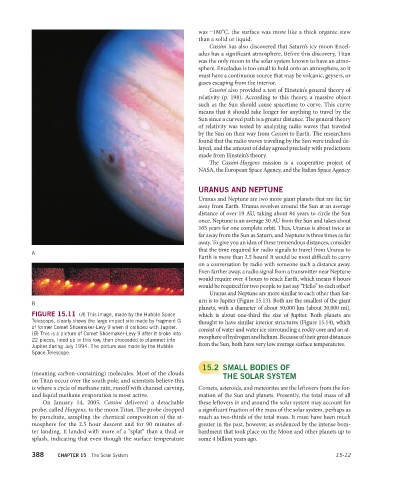
                   FIGURE 15.11  (A) This image, made by the Hubble Space   which is about one-third the size of Jupiter. Both planets are
                   Telescope, clearly shows the large impact site made by fragment G   thought to have similar interior structures (Figure 15.14), which
                   of former Comet Shoemaker-Levy 9 when it collided with Jupiter.   consist of water and water ice surrounding a rocky core and an at-
                   (B) This is a picture of Comet Shoemaker-Levy 9 after it broke into   mosphere of hydrogen and helium. Because of their great  distances
                   22 pieces, lined up in this row, then proceeded to plummet into
                   Jupiter during July 1994. The picture was made by the Hubble   from the Sun, both have very low average surface  temperatures.
                   Space Telescope.

                                                                             15.2  SMALL BODIES OF
                   (meaning  carbon-containing)  molecules. Most of the clouds    THE SOLAR SYSTEM
                   on Titan occur over the south pole, and scientists believe this
                   is where a cycle of methane rain, runoff with channel carving,   Comets, asteroids, and meteorites are the leftovers from the for-
                   and liquid methane evaporation is most active.         mation of the Sun and planets. Presently, the total mass of all
                      On January 14, 2005,  Cassini delivered a detachable   these leftovers in and around the solar system may account for
                   probe, called Huygens, to the moon Titan. The probe dropped   a significant fraction of the mass of the solar system, perhaps as
                   by parachute, sampling the chemical composition of the at-  much as two-thirds of the total mass. It must have been much
                   mosphere for the 2.5 hour descent and for 90 minutes af-  greater in the past, however, as evidenced by the intense bom-
                   ter landing. It landed with more of a “splat” than a thud or   bardment that took place on the Moon and other planets up to
                   splash, indicating that even though the surface temperature   some 4 billion years ago.

                   388     CHAPTER 15  The Solar System                                                                15-12

