


Page 436 - 9780077418427.pdf
P. 436
/Users/user-f465/Desktop
          tiL12214_ch16_405-432.indd Page 413  9/3/10  6:19 PM user-f465
          tiL12214_ch16_405-432.indd Page 413  9/3/10  6:19 PM user-f465                                                /Users/user-f465/Desktop


                                Summer solstice               Winter solstice  however, several different ways to describe the day, month, and
                                                                               year, and each depends on a different set of events. These events
                                Arctic                             23.5°       are described in the following section.
                                Circle
                        Tropic of
                        Cancer                                                 Daily Time
                        Equator                                                The technique of using astronomical motions for keeping time

                        Tropic of                    Surface of the Sun        originated some 4,000 years ago with the Babylonian culture.
                        Capricorn                                              The Babylonians marked the yearly journey of the Sun against
                                                                               the background of the stars, which was divided into 12 periods,
                            Antarctic                                          or months, after the signs of the zodiac. Based on this system,
                            Circle
                                                                               the Babylonian year was divided into 12 months with a total of
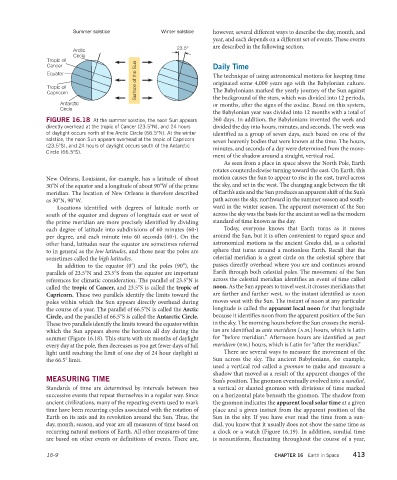
                       FIGURE 16.18  At the summer solstice, the noon Sun appears   360 days. In addition, the Babylonians invented the week and
                       directly overhead at the tropic of Cancer (23.5°N), and 24 hours   divided the day into hours, minutes, and seconds. The week was
                        of daylight occurs north of the Arctic Circle (66.5°N). At the winter   identified as a group of seven days, each based on one of the
                       solstice, the noon Sun appears overhead at the tropic of Capricorn   seven heavenly bodies that were known at the time. The hours,
                       (23.5°S), and 24 hours of daylight occurs south of the Antarctic
                                                                               minutes, and seconds of a day were determined from the move-
                       Circle (66.5°S).
                                                                               ment of the shadow around a straight, vertical rod.
                                                                                  As seen from a place in space above the North Pole, Earth
                                                                               rotates counterclockwise turning toward the east. On Earth, this
                       New Orleans, Louisiana, for example, has a latitude of about   motion causes the Sun to appear to rise in the east, travel across
                       30°N of the equator and a longitude of about 90°W of the prime   the sky, and set in the west. The changing angle between the tilt
                       meridian. The location of New Orleans is therefore described   of Earth’s axis and the Sun produces an apparent shift of the Sun’s
                       as 30°N, 90°W.                                          path across the sky, northward in the summer season and south-
                           Locations identified with degrees of latitude north or   ward in the winter season. The apparent movement of the Sun
                       south of the equator and degrees of longitude east or west of   across the sky was the basis for the ancient as well as the modern
                       the prime meridian are more precisely identified by dividing   standard of time known as the day.
                       each degree of latitude into subdivisions of 60 minutes (60∙)   Today, everyone knows that Earth turns as it moves
                       per degree, and each minute into 60 seconds (60∙). On the   around the Sun, but it is often convenient to regard space and
                       other hand, latitudes near the equator are sometimes referred   astronomical motions as the ancient Greeks did, as a celestial
                       to in general as the low latitudes, and those near the poles are   sphere that turns around a motionless Earth. Recall that the
                       sometimes called the high latitudes.                    celestial meridian is a great circle on the celestial sphere that
                           In addition to the equator (0°) and the poles (90°), the   passes directly overhead where you are and continues around
                       parallels of 23.5°N and 23.5°S from the equator are important   Earth through both celestial poles. The movement of the Sun
                       references for climatic consideration. The parallel of 23.5°N is   across the celestial meridian identifies an event of time called
                       called the tropic of Cancer, and 23.5°S is called the tropic of   noon. As the Sun appears to travel west, it crosses  meridians that
                       Capricorn. These two parallels identify the limits toward the   are farther and farther west, so the instant identified as noon
                       poles within which the Sun appears directly overhead during   moves west with the Sun. The instant of noon at any particular
                       the course of a year. The parallel of 66.5°N is called the Arctic   longitude is called the apparent local noon for that longitude
                       Circle, and the parallel of 66.5°S is called the Antarctic Circle.   because it identifies noon from the apparent position of the Sun
                       These two parallels identify the limits toward the equator within   in the sky. The morning hours before the Sun crosses the merid-
                       which the Sun appears above the horizon all day during the   ian are identified as ante meridiem (a.m.) hours, which is Latin
                       summer (Figure 16.18). This starts with six months of daylight   for “before meridian.” Afternoon hours are identified as  post
                       every day at the pole, then decreases as you get fewer days of full   meridiem (p.m.) hours, which is Latin for “after the meridian.”
                       light until reaching the limit of one day of 24 hour daylight at   There are several ways to measure the movement of the
                       the 66.5° limit.                                        Sun across the sky. The ancient Babylonians, for example,
                                                                               used a vertical rod called a gnomon to make and measure a
                                                                               shadow that moved as a result of the apparent changes of the
                       MEASURING TIME                                          Sun’s position. The gnomon eventually evolved into a sundial,
                       Standards of time are determined by intervals between two   a vertical or slanted gnomon with divisions of time marked
                       successive events that repeat themselves in a regular way. Since   on a horizontal plate beneath the gnomon. The shadow from
                         ancient civilizations, many of the repeating events used to mark   the gnomon indicates the apparent local solar time at a given
                       time have been recurring cycles associated with the rotation of   place and a given instant from the apparent position of the
                       Earth on its axis and its revolution around the Sun. Thus, the   Sun in the sky. If you have ever read the time from a sun-
                       day, month, season, and year are all measures of time based on   dial, you know that it usually does not show the same time as
                       recurring natural motions of Earth. All other measures of time   a clock or a watch (Figure 16.19). In addition, sundial time
                       are based on other events or definitions of events. There are,   is nonuniform, fluctuating throughout the course of a year,

                       16-9                                                                        CHAPTER 16  Earth in Space   413

