


Page 508 - 9780077418427.pdf
P. 508
/Users/user-f465/Desktop
          tiL12214_ch19_477-500.indd Page 485  9/3/10  6:22 PM user-f465
          tiL12214_ch19_477-500.indd Page 485  9/3/10  6:22 PM user-f465                                                /Users/user-f465/Desktop


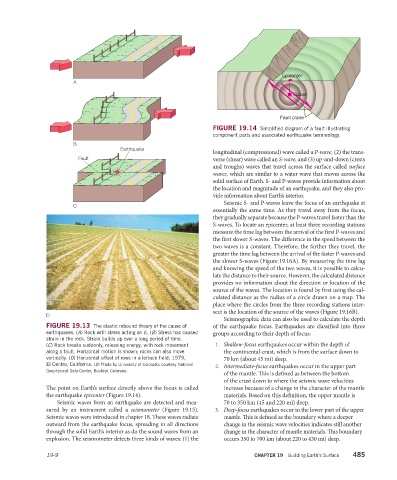
                                                                                                      Epicenter
                                A

                                                                                                         Focus


                                                                                                     Fault plane
                                                                               FIGURE 19.14  Simplified diagram of a fault illustrating
                                                                               component parts and associated earthquake terminology.
                                B
                                                Earthquake
                                                                               longitudinal (compressional) wave called a P-wave, (2) the trans-
                                  Fault                                        verse (shear) wave called an S-wave, and (3) up-and-down (crests
                                                                               and troughs) waves that travel across the surface called surface
                                                                               waves, which are similar to a water wave that moves across the
                                                                               solid surface of Earth. S- and P-waves provide information about
                                                                               the location and magnitude of an earthquake, and they also pro-
                                                                               vide information about Earth’s interior.
                                                                                  Seismic S- and P-waves leave the focus of an earthquake at
                                C
                                                                               essentially the same time. As they travel away from the focus,
                                                                               they gradually separate because the P-waves travel faster than the
                                                                               S-waves. To locate an epicenter, at least three recording  stations
                                                                               measure the time lag between the arrival of the first P-waves and
                                                                               the first slower S-waves. The difference in the speed between the
                                                                               two waves is a constant. Therefore, the farther they travel, the
                                                                               greater the time lag between the arrival of the faster P-waves and
                                                                               the slower S-waves (Figure 19.16A). By measuring the time lag
                                                                               and knowing the speed of the two waves, it is possible to calcu-
                                                                               late the distance to their source. However, the calculated distance
                                                                               provides no information about the direction or location of the
                                                                               source of the waves. The location is found by first using the cal-
                                                                               culated distance as the radius of a circle drawn on a map. The
                                                                               place where the circles from the three recording stations inter-
                                                                               sect is the location of the source of the waves (Figure 19.16B).
                        D
                                                                                  Seismographic data can also be used to calculate the depth
                       FIGURE 19.13  The elastic rebound theory of the cause of   of the earthquake focus. Earthquakes are classified into three
                       earthquakes. (A) Rock with stress acting on it. (B) Stress has caused   groups according to their depth of focus:
                       strain in the rock. Strain builds up over a long period of time.
                       (C) Rock breaks suddenly, releasing energy, with rock movement     1.  Shallow-focus earthquakes occur within the depth of
                       along a fault. Horizontal motion is shown; rocks can also move   the  continental crust, which is from the surface down to
                       vertically. (D) Horizontal offset of rows in a lettuce field, 1979,   70 km (about 45 mi) deep.
                       El Centro, California. (D) Photo by University of Colorado; courtesy National     2.  Intermediate-focus earthquakes occur in the upper part
                        Geophysical Data Center,  Boulder, Colorado.

                                                                                  of the mantle. This is defined as between the bottom

                                                                                  of the crust down to where the seismic wave velocities
                       The point on Earth’s surface directly above the focus is called   increase because of a change in the character of the mantle
                       the earthquake epicenter (Figure 19.14).                   materials. Based on this definition, the upper mantle is

                           Seismic waves from an earthquake are detected and mea-  70 to 350 km (45 and 220 mi) deep.
                       sured by an instrument called a  seismometer (Figure 19.15).     3.  Deep-focus earthquakes occur in the lower part of the upper
                         Seismic waves were introduced in chapter 18. These waves  radiate   mantle. This is defined as the boundary where a deeper


                       outward from the earthquake focus, spreading in all directions   change in the seismic wave velocities indicates still another
                       through the solid Earth’s interior as do the sound waves from an   change in the character of mantle materials. Th is boundary
                         explosion. The seismometer detects three kinds of waves: (1) the     occurs 350 to 700 km (about 220 to 430 mi) deep.
                       19-9                                                                 CHAPTER 19  Building Earth’s Surface   485

