


Page 506 - 9780077418427.pdf
P. 506
/Users/user-f465/Desktop
          tiL12214_ch19_477-500.indd Page 483  9/3/10  6:22 PM user-f465
          tiL12214_ch19_477-500.indd Page 483  9/3/10  6:22 PM user-f465                                                /Users/user-f465/Desktop


                                                                                                 Up
                                                                                                     Down

                                                                                        Hanging
                                                                                        wall           Footwall block
                        A
                                                                                        block
                                                                                       A
                                                                                                          Surface trace of fault

                                                                                                                Up Down

                       B

                                                                                   Fault

                                                                                       B
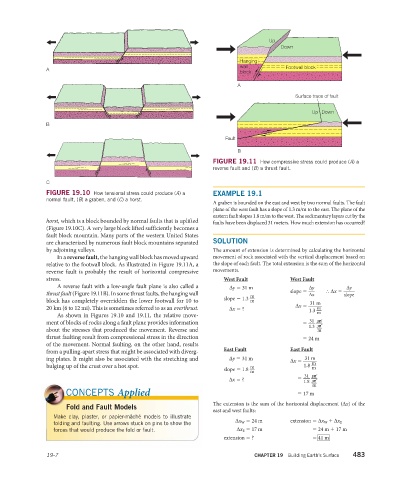
                                                                               FIGURE 19.11  How compressive stress could produce (A) a
                                                                               reverse fault and (B) a thrust fault.

                       C
                       FIGURE 19.10  How tensional stress could produce (A) a     EXAMPLE 19.1
                       normal fault, (B) a graben, and (C) a horst.
                                                                               A graben is bounded on the east and west by two normal faults. The fault
                                                                               plane of the west fault has a slope of 1.3 m/m to the east. The plane of the
                                                                               eastern fault slopes 1.8 m/m to the west. The sedimentary layers cut by the
                       horst, which is a block bounded by normal faults that is uplifted   faults have been displaced 31 meters. How much extension has occurred?
                       (Figure 19.10C). A very large block lifted sufficiently becomes a
                       fault block mountain. Many parts of the western United States
                       are characterized by numerous fault block mountains separated   SOLUTION
                       by adjoining valleys.                                   The amount of extension is determined by calculating the horizontal
                           In a reverse fault, the hanging wall block has moved upward   movement of rock associated with the vertical displacement based on
                       relative to the footwall block. As illustrated in  Figure 19.11A, a   the slope of each fault. The total extension is the sum of the horizontal
                       reverse fault is probably the result of horizontal compressive   movements.
                       stress.                                                    West Fault            West Fault
                           A reverse fault with a low-angle fault plane is also called a   Δy = 31 m          _           _
                                                                                                               Δy
                                                                                                                           Δy


                       thrust fault (Figure 19.11B). In some thrust faults, the hanging wall   m _      slope =           ∴ Δx =     slope
                                                                                                               Δx
                       block has completely overridden the lower footwall for 10 to   slope = 1.3  m          _
                                                                                                               31 m
                       20 km (6 to 12 mi). This is sometimes referred to as an  overthrust.  Δx = ?            Δx =     1.3
                                                                                                                 m _

                           As shown in Figures 19.10 and 19.11, the relative move-                               m
                                                                                                               31 _ m _
                       ment of blocks of rocks along a fault plane provides information                     =

                                                                                                              1.3 m _
                       about the stresses that produced the movement. Reverse and
                                                                                                                 m
                       thrust faulting result from compressional stress in the direction                    = 24 m
                       of the movement. Normal faulting, on the other hand, results
                       from a pulling-apart stress that might be associated with diverg-  East Fault    East Fault
                                                                                                             31 m
                       ing plates. It might also be associated with the stretching and   Δy = 31 m      Δx =   _

                                                                                                               m _

                       bulging up of the crust over a hot spot.                            m _               1.8
                                                                                                               m
                                                                                  slope = 1.8
                                                                                           m
                                                                                                             31 _ m _
                                                                                    Δx = ?                 =

                                                                                                             1.8 m _

                                                                                                                m
                              CONCEPTS Applied                                                             = 17 m
                                                                               The extension is the sum of the horizontal displacement (Δx) of the
                              Fold and Fault Models
                                                                               east and west faults:
                          Make clay, plaster, or papier-mâché models to illustrate
                                                                                      Δx W  = 24 m
                          folding and faulting. Use arrows stuck on pins to show the                    extension = Δx W  + Δx E
                          forces that would produce the fold or fault.                 Δx E  = 17 m             = 24 m + 17 m
                                                                                  extension = ?                 = 41 m
                       19-7                                                                 CHAPTER 19  Building Earth’s Surface   483

