


Page 507 - 9780077418427.pdf
P. 507
/Users/user-f465/Desktop
          tiL12214_ch19_477-500.indd Page 484  9/3/10  6:22 PM user-f465
          tiL12214_ch19_477-500.indd Page 484  9/3/10  6:22 PM user-f465                                                /Users/user-f465/Desktop


                   EXAMPLE 19.2
                   Suppose the vertical displacement in Example 19.1 is 500 m. How
                   much extension has occurred? (Answer: 660 m.)                        Eureka


                    19.3 EARTHQUAKES                                                               Reno
                                                                                                        Nevada
                   This section is concerned with the nature and origin of earth-
                                                                             San Francisco
                   quakes. The use of seismic waves to determine Earth’s internal
                   structure was discussed in chapter 18. In this section, seismic waves    California
                   of earthquakes will be considered in greater detail, along with how
                   the quakes are measured and located by measuring the waves. The
                   effects of earthquakes, such as ground motion, ground displace-
                   ment, damage, and tsunamis (“tidal waves”), will also be described.
                                                                                 Los Angeles

                   CAUSES OF EARTHQUAKES                                                      San Andreas fault
                   What is an earthquake? An  earthquake is a quaking, shak-                                        Arizona
                   ing, vibrating, or upheaval of the ground. Earthquakes are the
                   result of the sudden release of energy that comes from stress
                   on rock beneath Earth’s surface. In the section on diastrophism,
                   you learned that rock units can bend and become deformed in re-
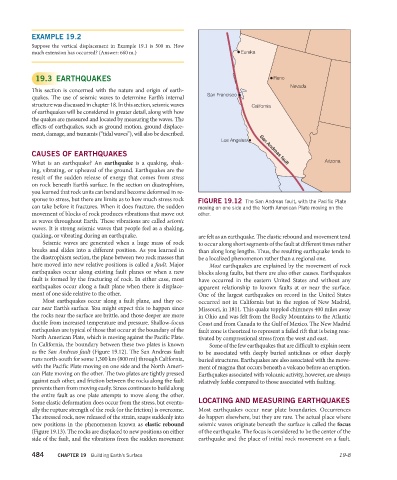
                   sponse to stress, but there are limits as to how much stress rock   FIGURE 19.12  The San Andreas fault, with the Pacific Plate
                   can take before it fractures. When it does fracture, the sudden   moving on one side and the North American Plate moving on the
                   movement of blocks of rock produces vibrations that move out   other.
                   as waves throughout Earth. These vibrations are called seismic
                   waves. It is strong seismic waves that people feel as a shaking,
                   quaking, or vibrating during an earthquake.            are felt as an earthquake. The elastic rebound and movement tend
                      Seismic waves are generated when a huge mass of rock   to occur along short segments of the fault at different times rather
                   breaks and slides into a different position. As you learned in   than along long lengths. Thus, the resulting earthquake tends to
                   the diastrophism section, the plane between two rock masses that   be a localized phenomenon rather than a regional one.
                   have moved into new relative positions is called a fault. Major   Most earthquakes are explained by the movement of rock
                   earthquakes occur along existing fault planes or when a new   blocks along faults, but there are also other causes. Earthquakes
                   fault is formed by the fracturing of rock. In either case, most   have occurred in the eastern United States and without any
                   earthquakes occur along a fault plane when there is displace-    apparent relationship to known faults at or near the surface.
                   ment of one side relative to the other.                One of the largest earthquakes on record in the United States
                      Most earthquakes occur along a fault plane, and they oc-  occurred not in California but in the region of New Madrid,
                   cur near Earth’s surface. You might expect this to happen since     Missouri, in 1811. This quake toppled chimneys 400 miles away
                   the rocks near the surface are brittle, and those deeper are more   in Ohio and was felt from the Rocky Mountains to the Atlantic
                   ductile from increased temperature and pressure. Shallow-focus   Coast and from Canada to the Gulf of Mexico. The New Madrid
                   earthquakes are typical of those that occur at the boundary of the   fault zone is theorized to represent a failed rift that is being reac-
                   North American Plate, which is moving against the Pacific Plate.   tivated by compressional stress from the west and east.
                   In California, the boundary between these two plates is known   Some of the few earthquakes that are difficult to explain seem
                   as the San Andreas fault (Figure 19.12). The San Andreas fault   to be associated with deeply buried anticlines or other deeply
                   runs north-south for some 1,300 km (800 mi) through California,   buried structures. Earthquakes are also associated with the move-
                   with the Pacific Plate mov ing on one side and the North Ameri-  ment of magma that occurs beneath a volcano before an eruption.
                   can Plate moving on the other. The two plates are tightly pressed   Earthquakes associated with volcanic activity, however, are always
                   against each other, and friction between the rocks along the fault   relatively feeble compared to those associated with faulting.
                   prevents them from moving easily. Stress continues to build along
                   the entire fault as one plate attempts to move along the other.
                   Some elastic deformation does occur from the stress, but eventu-  LOCATING AND MEASURING EARTHQUAKES
                   ally the rupture strength of the rock (or the friction) is overcome.   Most earthquakes occur near plate boundaries. Occurrences
                   The stressed rock, now released of the strain, snaps suddenly into   do happen elsewhere, but they are rare. The actual place where
                   new positions in the phenomenon known as  elastic rebound   seismic waves originate beneath the surface is called the focus
                   (Figure 19.13). The rocks are displaced to new positions on either   of the earthquake. The focus is considered to be the center of the
                   side of the fault, and the vibrations from the sudden movement   earthquake and the place of initial rock movement on a fault.

                   484     CHAPTER 19  Building Earth’s Surface                                                         19-8

