


Page 509 - 9780077418427.pdf
P. 509
/Users/user-f465/Desktop
          tiL12214_ch19_477-500.indd Page 486  9/3/10  6:22 PM user-f465
          tiL12214_ch19_477-500.indd Page 486  9/3/10  6:22 PM user-f465                                                /Users/user-f465/Desktop


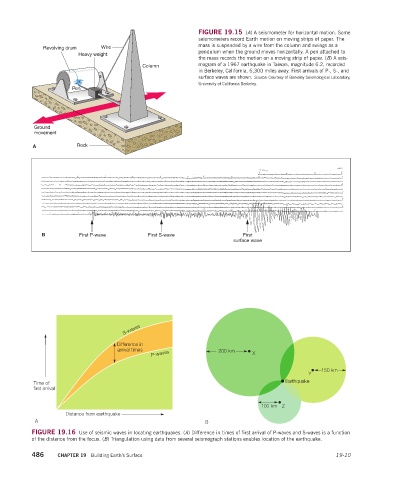
                                                                          FIGURE 19.15  (A) A seismometer for horizontal motion. Some
                                                                          seismometers record Earth motion on moving strips of paper. The
                                                                          mass is suspended by a wire from the column and swings as a
                      Revolving drum      Wire
                                                                          pendulum when the ground moves horizontally. A pen attached to
                                  Heavy weight
                                                                          the mass records the motion on a moving strip of paper. (B)  A seis-
                                                       Column             mogram of a 1967 earthquake in Taiwan, magnitude 6.2, recorded
                                                                          in Berkeley, California, 6,300 miles away. First arrivals of P-, S-, and
                                                                          surface waves are shown. Source: Courtesy of Berkeley Seismological Laboratory,
                                                                          University of California Berkeley.
                                Pen


                   Ground
                   movement
                   A              Rock


                      B           First P-wave           First S-wave                    First
                                                                                     surface wave


                                                 S-waves


                                               Difference in
                                               arrival times                     200 km
                                                          P-waves                           X

                                                                                                                   150 km
                                                                                                              Y
                   Time of                                                                             Earthquake
                   first arrival


                                                                                               100 km Z
                              Distance from earthquake
                    A                                                       B

                   FIGURE 19.16  Use of seismic waves in locating earthquakes. (A) Difference in times of first arrival of P-waves and S-waves is a function
                   of the distance from the focus. (B) Triangulation using data from several seismograph stations enables location of the earthquake.

                   486     CHAPTER 19  Building Earth’s Surface                                                        19-10

