


Page 510 - 9780077418427.pdf
P. 510
/Users/user-f465/Desktop
          tiL12214_ch19_477-500.indd Page 487  9/3/10  6:22 PM user-f465
          tiL12214_ch19_477-500.indd Page 487  9/3/10  6:22 PM user-f465                                                /Users/user-f465/Desktop


                           About 85 percent of all earthquakes are of a shallow
                         focus, occurring in the top 70 km (about 45 mi) of the sur-  Myths, Mistakes, & Misunderstandings
                       face. Only about 3 percent are earthquakes of a deep  focus.
                       Most earthquakes are shallow ones because (1) the nature of   Do Earthquakes Swallow People?
                       the rocks near the surface (brittle) differs from that of those   It is a myth that the ground opens up, swallows people, then
                         under great  pressure and higher temperatures (plastic) and   closes during an earthquake. There might be shallow crevasses
                       (2) the mechanism that results in earthquakes (plate tecton-  that form during an earthquake, but faults do not open up and
                       ics) has the greatest resistance to movement near the surface   close during an earthquake. Movement occurs along a fault, not
                                                                                 perpendicular to it. If faults opened up, no earthquake would
                       between the plates.
                                                                                 occur because there would be no friction to lock the sides of the
                                                                                 fault together.
                       MEASURING EARTHQUAKE STRENGTH
                       The intensities of earthquakes vary widely, from the many
                       that are barely detectable to the few that cause widespread   The size of an earthquake can be measured in terms of
                         destruction. Destruction is caused by the seismic waves, which     vibrations, in terms of displacement, or in terms of the amount
                       cause the land and buildings to vibrate. Vibrations during small   of energy released at the site of the earthquake. The larger the
                       quakes can crack windows and walls, but vibrations in strong   quake, the larger the waves recorded on a seismometer. From
                       quakes can topple buildings. For example, the January 2010   these recorded waves, scientists assign a number called the
                       strong Haiti earthquake collapsed more than 300,000 buildings,   magnitude. Magnitude is a measure of the energy released dur-
                       and the February 2010 stronger Chile earthquake collapsed   ing an earthquake. Earthquake magnitude is often reported by
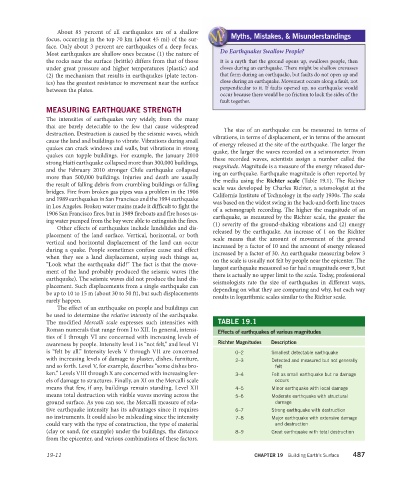
                       more than 500,000 buildings. Injuries and death are usually   the media using the  Richter scale (Table 19.1). The Richter
                       the result of falling debris from crumbling buildings or falling   scale was developed by Charles Richter, a seismologist at the
                       bridges. Fire from broken gas pipes was a problem in the 1906   California Institute of Technology in the early 1930s. The scale
                       and 1989 earthquakes in San Francisco and the 1994 earthquake   was based on the widest swing in the back-and-forth line traces
                       in Los Angeles. Broken water mains made it difficult to fight the   of a seismograph recording. The higher the magnitude of an
                       1906 San Francisco fires, but in 1989 fireboats and fire hoses us-  earthquake, as measured by the Richter scale, the greater the
                       ing water pumped from the bay were able to extinguish the fires.  (1) severity of the ground-shaking vibrations and (2) energy
                           Other effects of earthquakes include landslides and dis-  released by the earthquake. An increase of 1 on the Richter
                       placement of the land surface. Vertical, horizontal, or both   scale means that the amount of movement of the ground
                         vertical and horizontal displacement of the land can occur   increased by a factor of 10 and the amount of energy released
                       during a quake. People sometimes confuse cause and effect   increased by a factor of 30. An earthquake mea suring below 3
                       when they see a land displacement, saying such things as,   on the scale is usually not felt by people near the epicenter. The
                       “Look what the earthquake did!” The fact is that the move-  largest earthquake measured so far had a magnitude over 9, but
                       ment of the land probably produced the seismic waves (the   there is actually no upper limit to the scale. Today, professional
                       earthquake). The seismic waves did not produce the land dis-  seismologists rate the size of earthquakes in dif ferent ways,
                       placement. Such  displacements from a single earthquake can   depending on what they are comparing and why, but each way
                       be up to 10 to 15 m (about 30 to 50 ft), but such displacements   results in logarithmic scales similar to the Richter scale.
                       rarely happen.
                           The effect of an earthquake on people and buildings can
                       be used to determine the relative intensity of the earthquake.
                       The modified  Mercalli scale expresses such intensities with   TABLE 19.1
                       Roman numerals that range from I to XII. In general, intensi-  Effects of earthquakes of various magnitudes
                       ties of I through VI are concerned with increasing levels of
                       awareness by people. Intensity level I is “not felt,” and level VI   Richter Magnitudes  Description
                       is “felt by all.” Intensity levels V through VII are concerned      0–2    Smallest detectable earthquake
                       with increasing levels of damage to plaster, dishes, furniture,   2–3      Detected and measured but not generally
                       and so forth. Level V, for example, describes “some dishes bro-             felt
                       ken.” Levels VIII through X are concerned with increasing lev-  3–4        Felt as small earthquake but no damage
                       els of damage to structures. Finally, an XI on the Mercalli scale           occurs
                       means that few, if any, buildings remain standing. Level XII      4–5      Minor earthquake with local damage
                       means total destruction with visible waves moving across the   5–6         Moderate earthquake with structural
                       ground surface. As you can see, the Mercalli measure of rela-               damage
                       tive earthquake intensity has its advantages since it requires      6–7    Strong earthquake with destruction
                       no instruments. It could also be misleading since the intensity   7–8      Major earthquake with extensive damage
                       could vary with the type of construction, the type of material              and destruction
                       (clay or sand, for example) under the buildings, the distance      8–9     Great earthquake with total destruction
                       from the epicenter, and various combinations of these factors.

                       19-11                                                                CHAPTER 19  Building Earth’s Surface   487

