


Page 516 - 9780077418427.pdf
P. 516
/Users/user-f465/Desktop
          tiL12214_ch19_477-500.indd Page 493  9/3/10  6:23 PM user-f465
          tiL12214_ch19_477-500.indd Page 493  9/3/10  6:23 PM user-f465                                                /Users/user-f465/Desktop


                                                                                            A Closer Look


                                                                                         Volcanoes Change the World
                              volcanic eruption changes the local   What were the effects of volcanic haze   global temperatures by a few tenths of a
                          A  landscape, that much is obvious. What   from Tambora around the entire world?   degree for two or three years. The cooling
                          is not so obvious are the worldwide changes   There were fantastic, brightly colored sunsets   did take place, but the actual El  Chichon
                          that can happen just because of the eruption   from the added haze in the stratosphere. On   contribution to the cooling is not clear
                          of a single volcano. Perhaps the most dis-  the other hand, it was also cooler than usual,   because of other interactions. Earth may
                          cussed change brought about by a volcano   presumably because of the reflected sunlight   have been undergoing global warming from
                          occurred back in 1815–1816 after the erup-  that did not reach Earth’s surface. It snowed   the greenhouse effect, for example, so the El
                          tion of Tambora in Indonesia. The Tam-  in New England in June 1816, and the cold   Chichon cooling effect could have actually
                          bora eruption was massive, blasting huge   continued into July. Crops failed, and 1816   been much greater. Other complicating
                          amounts of volcanic dust, ash, and gas high   became known as the “year without summer.”  factors such as the effects of El Niño or
                          into the atmosphere. Most of the ash and   More information is available about   La Niña (see chapter 23) make changes
                          dust fell back to Earth around the volcano,   the worldwide effects of  present-day volcanic   difficult to predict.
                          but some dust particles and sulfur dioxide   eruptions because there are now instruments  In June 1991, the Philippine volcano
                          gas were pushed high into the stratosphere.  to make more observations in more places.   Mount Pinatubo erupted, blasting twice as
                             It is known today that the sulfur dioxide   However, it is still necessary to do a great   much gas and dust into the stratosphere as
                          from explosive volcanic eruptions reacts with   deal of estimating because of the relative   El Chichon had about a decade earlier. Dust
                          water vapor in the stratosphere, forming tiny   inaccessibility of the worldwide strato-  from Mount Pinatubo remained in Earth’s
                          droplets of diluted sulfuric acid. In the   sphere. It was estimated, for example, that   atmosphere for the next 10 years. The haze
                          stratosphere, there is no convection, so the   the 1982 eruption of El Chichon in Mexico   from such eruptions has the potential to cool
                          droplets of acid and dust from the volcano   created enough haze in the stratosphere to   the climate about 0.5°C (1°F). The overall
                          eventually form a layer around the entire   reflect 5 percent of the solar radiation away   result, however, will always depend on a pos-
                          globe. This haze remains in the stratosphere   from Earth. Researchers also estimated   sible greenhouse effect, a possible El Niño or
                          for years, reflecting and scattering sunlight.  that the El Chichon eruption cooled the   La Niña effect, and other complications.


                                                                           Mt. Garibaldi
                                                                                                 CANADA
                                                                         Vancouver
                                                                                                   U.S.A.
                                                                                Mt. Baker
                                                              Vancouver Island
                                                                                Glacier Peak        MONTANA
                                                                     Seattle
                                                                                WASHINGTON
                                                                              Mt. Rainier
                                                                                              Columbia
                                                                               Mt. Adams
                                                    Juan de Fuca     Portland                  Plateau Basalts
                                                        Plate               Mt. St. Helens
                                                                              Mt. Hood
                                                                                   OREGON
                                                                               Mt. Jefferson
                                                                                                IDAHO
                                                                              Three Sisters
                                                                              North American Plate
                                            Pacific Plate                     Crater Lake
                                                                             Mt. Shasta
                                                                                Lassen
                                                                                Peak
                                                                                           NEVADA         UTAH


                                                                           CALIFORNIA
                                                                 San Francisco
                                                                                   Mono Craters
                                             0      200
                                              Kilometers

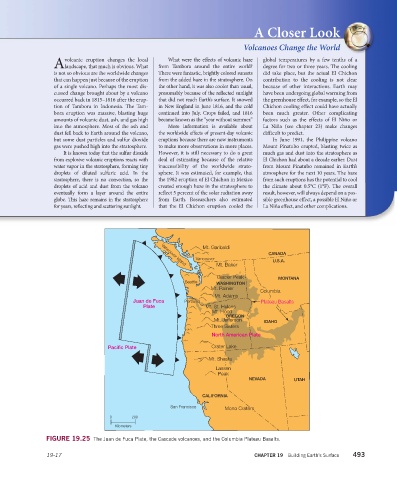
                       FIGURE 19.25  The Juan de Fuca Plate, the Cascade volcanoes, and the Columbia Plateau Basalts.

                       19-17                                                                CHAPTER 19  Building Earth’s Surface   493

