


Page 515 - 9780077418427.pdf
P. 515
/Users/user-f465/Desktop
          tiL12214_ch19_477-500.indd Page 492  9/3/10  6:23 PM user-f465
          tiL12214_ch19_477-500.indd Page 492  9/3/10  6:23 PM user-f465                                                /Users/user-f465/Desktop


                                               Crater                        Hogback
                   More recent flows and deposits                                                                   Laccolith


                   Older ash deposits


                   Older lava flows                                                 Dike
                                                                                                  Sill

                                                                            Batholith

                                                                                            Stock       Dike

                                                                                                                Sedimentary rock

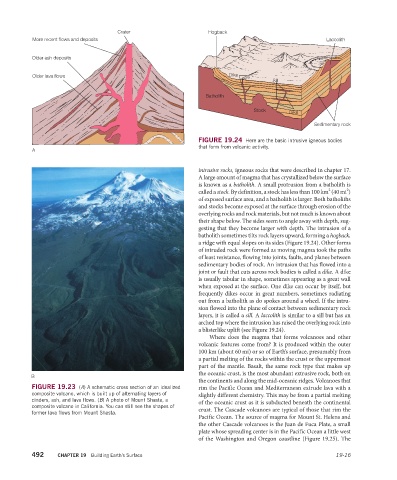
                                                                          FIGURE 19.24  Here are the basic intrusive igneous bodies
                                                                          that form from volcanic activity.
                   A


                                                                          intrusive rocks, igneous rocks that were described in chapter 17.
                                                                          A large amount of magma that has crystallized below the surface
                                                                          is known as a batholith. A small protrusion from a batholith is
                                                                                                                     2
                                                                                                                           2
                                                                          called a stock. By definition, a stock has less than 100 km  (40 mi )
                                                                          of exposed surface area, and a batholith is larger. Both batholiths
                                                                          and stocks become exposed at the surface through erosion of the
                                                                          overlying rocks and rock materials, but not much is known about
                                                                          their shape below. The sides seem to angle away with depth, sug-
                                                                          gesting that they  become larger with depth. The intrusion of a
                                                                          batholith sometimes tilts rock layers upward, forming a hogback,
                                                                          a ridge with equal slopes on its sides (Figure 19.24). Other forms
                                                                          of  intruded rock were formed as moving magma took the paths
                                                                          of least  resistance, flowing into joints, faults, and planes between
                                                                          sedimentary bodies of rock. An intrusion that has flowed into a
                                                                          joint or fault that cuts across rock bodies is called a dike. A dike
                                                                          is usually tabular in shape, sometimes appearing as a great wall
                                                                          when exposed at the  surface. One dike can occur by itself, but
                                                                          frequently dikes occur in great numbers, sometimes radiating
                                                                          out from a batholith as do spokes around a wheel. If the intru-
                                                                          sion flowed into the plane of contact between sedimentary rock
                                                                          layers, it is called a sill. A laccolith is similar to a sill but has an
                                                                          arched top where the intrusion has raised the overlying rock into
                                                                          a blisterlike uplift (see Figure 19.24).
                                                                             Where does the magma that forms volcanoes and other
                                                                          volcanic features come from? It is produced within the outer
                                                                          100 km (about 60 mi) or so of Earth’s surface, presumably from
                                                                          a partial melting of the rocks within the crust or the  uppermost
                                                                          part of the mantle. Basalt, the same rock type that makes up
                                                                          the oceanic crust, is the most abundant extrusive rock, both on
                   B
                                                                          the continents and along the mid-oceanic ridges. Volcanoes that
                   FIGURE 19.23  (A) A schematic cross section of an idealized   rim the Pacific Ocean and Mediterranean  extrude lava with a
                   composite volcano, which is built up of alternating layers of   slightly different chemistry. This may be from a partial melting
                   cinders, ash, and lava flows. (B) A photo of Mount Shasta, a   of the oceanic crust as it is subducted  beneath the  continental
                   composite volcano in California. You can still see the shapes of
                                                                          crust. The Cascade volcanoes are typical of those that rim the
                   former lava flows from Mount Shasta.
                                                                          Pacific Ocean. The source of magma for Mount St. Helens and
                                                                          the other Cascade volcanoes is the Juan de Fuca Plate, a small
                                                                          plate whose spreading center is in the  Pacific Ocean a little west
                                                                          of the  Washington and Oregon coastline (Figure 19.25). The

                   492     CHAPTER 19  Building Earth’s Surface                                                        19-16

