


Page 513 - 9780077418427.pdf
P. 513
/Users/user-f465/Desktop
          tiL12214_ch19_477-500.indd Page 490  9/3/10  6:22 PM user-f465
          tiL12214_ch19_477-500.indd Page 490  9/3/10  6:22 PM user-f465                                                /Users/user-f465/Desktop


                                     Oldest formation exposed on the surface  smell some of these gases around volcanic vents and hot springs.
                                                                          Hydrogen sulfide smells like rotten eggs or sewer gas. The sulfur
                                                     Youngest formation
                                                                          smells like a wooden match that has just been struck.
                                                                             The gases dissolved in magma play a major role in forcing
                                                                          magma out of the ground. As magma nears the surface, it comes
                                                                          under less pressure, and this releases some of the  dissolved gases
                                                                          from the magma. The gases help push the magma out of the
                                                                          ground. This process is similar to releasing the pressure on a can
                                                                          of warm soda, which releases dissolved carbon dioxide.
                                                                             Magma works its way upward from its source below to Earth’s
                                                                          surface, here to erupt into a lava flow or a volcano. A volcano is a
                                                                          hill or mountain formed by the extrusion of lava or rock fragments
                                                                          from magma below. Some lavas have a lower viscosity than others,
                   A
                                                                          are more fluid, and flow out over the land rather than forming a
                                                                          volcano. Such lava flows can accumulate into a plateau of basalt,
                                                                          the rock that the lava formed as it cooled and solidified. The
                                                                          Columbia Plateau of the states of Washington, Idaho, and Oregon
                                                                          is made up of layer after layer of basalt that  accumulated from lava
                                                                          flows. Individual flows of lava formed basalt layers up to 100 m
                                                                          (about 330 ft) thick, covering an area of hundreds of square kilo-
                                                                          meters. In places, the Columbia Plateau is up to 3 km (about 2 mi)
                                                                          thick from the accumulation of many  individual lava flows.
                                                                             The hill or mountain of a volcano is formed by ejected
                                                                            material that is deposited in a conical shape. The materials are
                                                                          deposited around a central  vent, an opening through which
                                                                          an eruption takes place. The crater of a volcano is a basinlike
                                                                            depression over a vent at the summit of the cone. Figure 19.20
                                                                          is an aerial view of Mount St. Helens, looking down into the
                   B                                                      crater at a volcanic dome that formed as magma periodically
                                                                          welled upward into the floor of the crater. This photo was taken
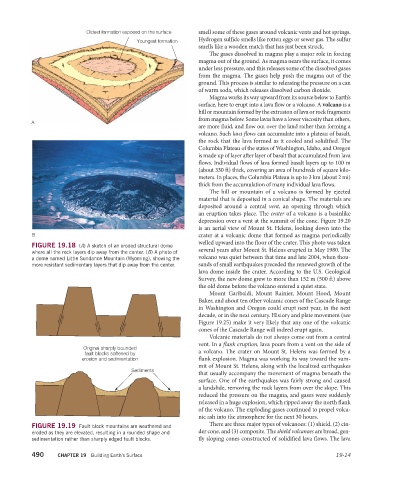
                   FIGURE 19.18  (A) A sketch of an eroded structural dome
                   where all the rock layers dip away from the center. (B) A photo of   several years after Mount St. Helens erupted in May 1980. The
                   a dome named Little Sundance Mountain (Wyoming), showing the   volcano was quiet between that time and late 2004, when thou-
                   more resistant sedimentary layers that dip away from the center.  sands of small earthquakes preceded the renewed growth of the
                                                                          lava dome inside the crater. According to the U.S.  Geological
                                                                          Survey, the new dome grew to more than 152 m (500 ft) above
                                                                          the old dome before the volcano entered a quiet state.
                                                                             Mount Garibaldi, Mount Rainier, Mount Hood, Mount
                                                                          Baker, and about ten other  volcanic cones of the Cascade Range
                                                                          in Washington and  Oregon could erupt next year, in the next
                                                                          decade, or in the next century. History and plate movement (see
                                                                          Figure 19.25) make it very likely that any one of the volcanic
                                                                          cones of the Cascade Range will indeed erupt again.
                                                                             Volcanic materials do not always come out from a central
                                                                          vent. In a flank eruption, lava pours from a vent on the side of
                                    Original sharply bounded
                                    fault blocks softened by              a volcano. The crater on Mount St. Helens was formed by a
                                   erosion and sedimentation              flank explosion. Magma was working its way toward the sum-
                                                                          mit of Mount St. Helens, along with the localized earthquakes
                                                    Sediments
                                                                          that usually accompany the movement of magma beneath the
                                                                            surface. One of the earthquakes was fairly strong and caused
                                                                          a landslide, removing the rock layers from over the slope. This
                                                                           reduced the pressure on the magma, and gases were suddenly
                                                                          released in a huge explosion, which ripped away the north flank
                                                                          of the volcano. The exploding gases continued to propel volca-
                                                                          nic ash into the atmosphere for the next 30 hours.
                                                                             There are three major types of volcanoes: (1) shield, (2) cin-
                   FIGURE 19.19  Fault block mountains are weathered and
                   eroded as they are elevated, resulting in a rounded shape and   der cone, and (3) composite. The shield volcanoes are broad, gen-
                   sedimentation rather than sharply edged fault blocks.  tly sloping cones constructed of solidified lava flows. The lava

                   490     CHAPTER 19  Building Earth’s Surface                                                        19-14

