


Page 512 - 9780077418427.pdf
P. 512
/Users/user-f465/Desktop
          tiL12214_ch19_477-500.indd Page 489  9/3/10  6:22 PM user-f465
          tiL12214_ch19_477-500.indd Page 489  9/3/10  6:22 PM user-f465                                                /Users/user-f465/Desktop


                       waves struck the coast of the Indian Ocean, with an estimated
                       death toll of about 295,000 and over a million left homeless.
                           The world’s largest recorded earthquakes have all oc-
                       curred where one tectonic plate subducts beneath another.
                       These  include the magnitude-9.5 1960 Chile earthquake, the
                         magnitude-9.2 1964 Prince William Sound, Alaska, earth-
                       quake, the magnitude-9.1 1957 Andreanof Islands, Alaska,
                       earthquake, and the magnitude-9.0 1952 Kamchatka, Russia,
                       earthquake. Such earthquakes often create large tsunamis that
                       result in death and destruction over a wide area.


                         19.4  ORIGIN OF MOUNTAINS
                       Most of the interesting features of Earth’s surface have been
                       created by folding and faulting, and the most prominent of
                       these features are mountains. Mountains are elevated parts of
                       Earth’s crust that rise abruptly above the surrounding surface.
                       Most mountains do not occur in isolation but in groups that are
                       associated in chains or belts. These long, thin belts are generally
                       found along the edges of continents rather than in the continen-
                       tal interior. There are a number of complex processes involved
                       in the origin of mountains and mountain chains, and no two
                       mountains are exactly alike. For convenience, however, moun-
                       tains can be classified according to three basic origins: (1) fold-
                       ing, (2) faulting, and (3) volcanic activity.


                       FOLDED AND FAULTED MOUNTAINS
                       The major mountain ranges of Earth—the Appalachian, Rocky,
                       and Himalayan mountains, for example—have a great vertical re-
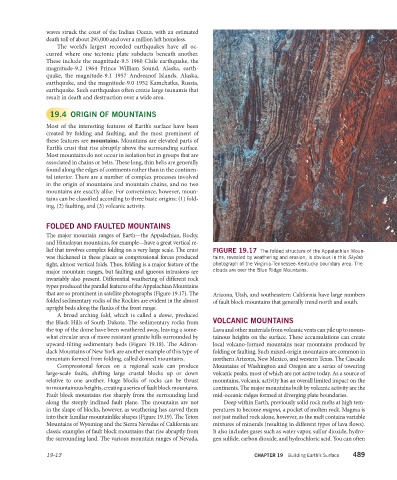
                       lief that involves complex folding on a very large scale. The crust   FIGURE 19.17  The folded structure of the Appalachian Moun-
                       was thickened in these places as compressional forces produced   tains, revealed by weathering and erosion, is obvious in this Skylab
                       tight, almost vertical folds. Thus, folding is a major feature of the   photograph of the Virginia-Tennessee-Kentucky boundary area. The
                       major mountain ranges, but faulting and igneous intrusions are   clouds are over the Blue Ridge Mountains.
                       invariably also present. Differential weathering of different rock
                       types produced the parallel features of the  Appalachian Mountains
                       that are so prominent in satellite photographs (Figure 19.17). The   Arizona, Utah, and southeastern California have large  numbers
                       folded sedimentary rocks of the Rockies are evident in the almost   of fault block mountains that generally trend north and south.
                       upright beds along the flanks of the front range.
                           A broad arching fold, which is called a  dome, produced
                       the Black Hills of South Dakota. The sedimentary rocks from   VOLCANIC MOUNTAINS
                       the top of the dome have been weathered away, leaving a some-  Lava and other materials from volcanic vents can pile up to moun-
                       what circular area of more resistant granite hills  surrounded by   tainous heights on the surface. These accumulations can create
                       upward-tilting sedimentary beds (Figure 19.18). The Adiron-  local volcano-formed mountains near mountains produced by
                       dack Mountains of New York are another example of this type of   folding or faulting. Such mixed-origin mountains are common in
                       mountain formed from folding, called domed mountains.   northern Arizona, New Mexico, and western Texas. The Cascade
                           Compressional forces on a regional scale can produce   Mountains of Washington and Oregon are a series of towering
                       large-scale faults, shifting large crustal blocks up or down   volcanic peaks, most of which are not active today. As a source of
                       relative to one another. Huge blocks of rocks can be thrust   mountains, volcanic activity has an overall limited impact on the
                       to mountainous heights, creating a  series of fault block mountains.   continents. The major mountains built by volcanic activity are the
                       Fault block mountains rise sharply from the surrounding land   mid-oceanic ridges formed at diverging plate boundaries.
                       along the steeply inclined fault plane. The mountains are not   Deep within Earth, previously solid rock melts at high tem-
                       in the shape of blocks, however, as weathering has carved them   peratures to become magma, a pocket of molten rock. Magma is
                       into their familiar mountainlike shapes (Figure 19.19). The Teton   not just melted rock alone, however, as the melt contains variable
                       Mountains of Wyoming and the Sierra Nevadas of California are   mixtures of minerals (resulting in different types of lava flows).
                       classic  examples of fault block mountains that rise abruptly from   It also includes gases such as water vapor, sulfur dioxide, hydro-
                       the surrounding land. The various mountain ranges of Nevada,   gen sulfide, carbon dioxide, and hydrochloric acid. You can often

                       19-13                                                                CHAPTER 19  Building Earth’s Surface   489

