


Page 517 - 9780077418427.pdf
P. 517
/Users/user-f465/Desktop
          tiL12214_ch19_477-500.indd Page 494  9/3/10  6:23 PM user-f465
          tiL12214_ch19_477-500.indd Page 494  9/3/10  6:23 PM user-f465                                                /Users/user-f465/Desktop


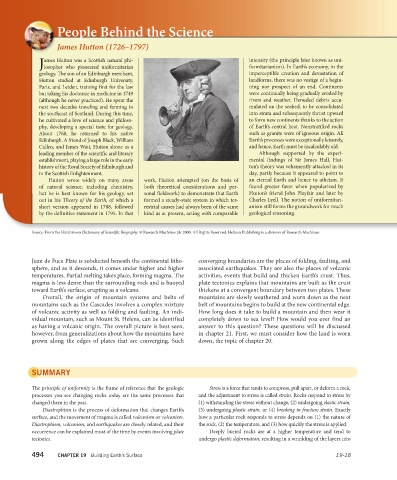
                           People Behind the Science


                           James Hutton (1726–1797)

                       ames Hutton was a Scottish natural phi-                             intensity (the principle later known as uni-
                     Jlosopher who pioneered uniformitarian                                formitarianism). In Earth’s economy, in the
                     geology. The son of an Edinburgh  merchant,                           imperceptible creation and devastation of
                     Hutton studied at Edinburgh Uni versity,                              landforms, there was no vestige of a begin-

                     Paris, and Leiden, training first for the law                         ning nor prospect of an end. Continents
                     but taking his doctorate in medicine in 1749                          were continually being gradually eroded by
                     (although he never practiced). He spent the                           rivers and weather. Denuded debris accu-
                     next two decades traveling and farming in                             mulated on the seabed, to be consolidated
                     the southeast of Scotland. During this time,                          into strata and subsequently thrust upward
                     he cultivated a love of science and philoso-                          to form new continents thanks to the action
                     phy, developing a special taste for  geology.                         of Earth’s central heat. Nonstratified rocks
                     About 1768, he returned to his native                                 such as granite were of igneous origin. All
                     Edinburgh. A friend of Joseph Black, William                          Earth’s processes were exceptionally leisurely,
                     Cullen, and James Watt, Hutton shone as a                             and hence, Earth must be incalculably old.
                     leading member of the scientific and literary                            Although supported by the experi-
                     establishment, playing a large role in the early                      mental findings of Sir James Hall, Hut-
                     history of the Royal Society of Edinburgh and                         ton’s theory was vehemently attacked in its
                     in the Scottish Enlight enment.                                       day, partly because it appeared to point to
                        Hutton wrote widely on many areas   work, Hutton attempted (on the basis of   an eternal Earth and hence to atheism. It
                     of natural science, including chemistry,   both theoretical considerations and per-  found greater favor when popularized by
                     but he is best known for his geology, set   sonal fieldwork) to demonstrate that Earth   Hutton’s friend John Playfair and later by
                     out in his Theory of the Earth, of which a   formed a steady-state system in which ter-  Charles Lyell. The notion of uniformitari-
                     short version appeared in 1788, followed   restrial causes had always been of the same   anism still forms the groundwork for much
                     by the definitive statement in 1795. In that   kind as at present, acting with comparable   geological reasoning.


                   Source: From the Hutchinson Dictionary of Scientific Biography. © Research Machines plc 2003. All Rights Reserved. Helicon Publishing is a division of Research Machines.


                   Juan de Fuca Plate is subducted  beneath the continental litho-  converging boundaries are the places of folding, faulting, and
                   sphere, and as it descends, it comes under higher and higher   associated earthquakes. They are also the places of volcanic
                   temperatures. Partial melting takes place, forming magma. The   activities, events that build and thicken Earth’s crust. Thus,
                   magma is less dense than the surrounding rock and is buoyed   plate tectonics explains that mountains are built as the crust
                   toward Earth’s surface, erupting as a volcano.         thickens at a convergent boundary between two plates. These
                      Overall, the origin of mountain systems and belts of   mountains are slowly weathered and worn down as the next
                   mountains such as the Cascades involves a complex mixture   belt of mountains begins to build at the new continental edge.
                   of volcanic activity as well as folding and faulting. An indi-  How long does it take to build a mountain and then wear it
                   vidual mountain, such as Mount St. Helens, can be identified   completely down to sea level? How would you ever find an
                   as having a volcanic origin. The overall picture is best seen,   answer to this question? These  questions will be discussed
                   however, from generalizations about how the mountains have   in chapter 21. First, we must consider how the land is worn
                   grown along the edges of plates that are converging. Such   down, the topic of chapter 20.


                   SUMMARY

                   The principle of uniformity is the frame of reference that the geologic   Stress is a force that tends to compress, pull apart, or deform a rock,
                   processes you see changing rocks today are the same processes that   and the adjustment to stress is called strain. Rocks respond to stress by
                   changed them in the past.                              (1) withstanding the stress without change, (2) undergoing elastic strain,
                      Diastrophism is the process of deformation that changes Earth’s   (3) undergoing plastic strain, or (4) breaking in fracture strain. Exactly
                   surface, and the movement of magma is called vulcanism or volcanism.   how a particular rock responds to stress depends on (1) the nature of
                   Diastrophism, volcanism, and earthquakes are closely related, and their   the rock, (2) the temperature, and (3) how quickly the stress is applied.
                   occurrence can be explained most of the time by events involving plate   Deeply buried rocks are at a higher temperature and tend to
                   tectonics.                                              undergo plastic deformation, resulting in a wrinkling of the layers into

                   494     CHAPTER 19  Building Earth’s Surface                                                        19-18

