


Page 61 - 9780077418427.pdf
P. 61
/Users/user-f465/Desktop
          tiL12214_ch02_025-060.indd Page 38  9/1/10  9:55 PM user-f465
          tiL12214_ch02_025-060.indd Page 38  9/1/10  9:55 PM user-f465                                                 /Users/user-f465/Desktop


                   not exactly, the acceleration due to gravity in any particular lo-
                   cation. The acceleration due to gravity is important in a number
                   of situations, so the acceleration from this force is given a spe-
                   cial symbol, g.


                   EXAMPLE 2.7
                   A rock that is dropped into a well hits the water in 3.0 s. Ignoring air
                   resistance, how far is it to the water?


                   SOLUTION 1
                   The problem concerns a rock in free fall. The time of fall (t) is given,
                   and the problem asks for a distance (d). Since the rock is in free fall,
                   the acceleration due to the force of gravity (g) is implied. The metric
                                          2
                   value and unit for  g is 9.8 m/s , and the English value and unit is
                       2
                   32 ft/s . You would use the metric g to obtain an answer in meters
                   and the English unit to obtain an answer in feet. Equation 2.4, d =
                       2
                   1/2  at , gives a relationship between distance (d), time (t), and average
                   acceleration (a). The acceleration in this case is the acceleration due
                   to gravity (g), so
                                            1 _  2               2
                      t = 3.0 s         d =     gt  (a = g = 9.8 m/s )


                                            2
                      g = 9.8 m/s 2         1 _
                                                   2


                      d = ?             d =     (9.8 m/s )(3.0 s) 2
                                            2
                                                      2
                                                 2
                                         = (4.9 m/s )(9.0 s )
                                             m·s
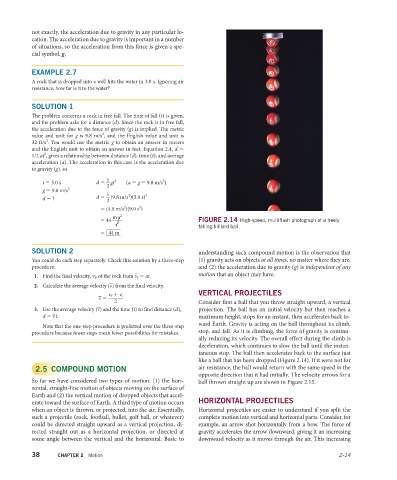
                                         = 44   _ 2                       FIGURE 2.14  High-speed, multiflash photograph of a freely


                                              s 2                         falling billiard ball.
                                         =   44 m
                   SOLUTION 2                                             understanding such compound motion is the  observation that
                   You could do each step separately. Check this solution by a three-step   (1) gravity acts on objects at all times, no matter where they are,
                   procedure:                                             and (2) the acceleration due to gravity (g) is  independent of any
                     1.  Find the final velocity, v f , of the rock from v f  = at.  motion that an object may have.
                     2.  Calculate the average velocity (v )  from the final velocity.
                                         −     v  =    _                  VERTICAL PROJECTILES
                                            v f  + v i


                                              2                           Consider first a ball that you throw straight upward, a vertical
                                        −

                     3.   Use the average velocity (   v ) and the time (t) to find distance (d),   projection. The ball has an initial velocity but then reaches a
                          −
                      d =    v  t.                                        maximum height, stops for an instant, then accelerates back to-
                                                                          ward Earth. Gravity is acting on the ball throughout its climb,
                      Note that the one-step procedure is preferred over the three-step
                   procedure because fewer steps mean fewer possibilities for mistakes.  stop, and fall. As it is climbing, the force of gravity is continu-
                                                                          ally reducing its velocity. The overall effect during the climb is
                                                                          deceleration, which continues to slow the ball until the instan-
                                                                          taneous stop. The ball then accelerates back to the surface just
                                                                          like a ball that has been dropped (Figure 2.14). If it were not for
                    2.5 COMPOUND MOTION                                   air resistance, the ball would return with the same speed in the
                                                                          opposite direction that it had initially. The velocity arrows for a
                   So far we have considered two types of motion: (1) the hori-  ball thrown straight up are shown in  Figure 2.15.
                   zontal, straight-line motion of objects moving on the surface of
                   Earth and (2) the vertical motion of dropped objects that accel-
                   erate toward the surface of Earth. A third type of motion  occurs   HORIZONTAL PROJECTILES
                   when an object is thrown, or projected, into the air.  Essentially,   Horizontal projectiles are easier to understand if you split the
                   such a projectile (rock, football, bullet, golf ball, or whatever)   complete motion into vertical and horizontal parts. Consider, for
                   could be directed straight upward as a vertical  projection, di-  example, an arrow shot horizontally from a bow. The force of
                   rected straight out as a horizontal projection, or  directed at   gravity accelerates the arrow downward, giving it an increasing
                   some angle between the vertical and the horizontal. Basic to   downward velocity as it moves through the air. This increasing

                   38      CHAPTER 2 Motion                                                                             2-14

