


Page 62 - 9780077418427.pdf
P. 62
/Users/user-f465/Desktop
          tiL12214_ch02_025-060.indd Page 39  9/1/10  9:55 PM user-f465
          tiL12214_ch02_025-060.indd Page 39  9/1/10  9:55 PM user-f465                                                 /Users/user-f465/Desktop


                                                                                            A Closer Look


                                                                                                               Free Fall
                             here are two different meanings for the   ward. The resisting force is determined by   130 mi/h). The air resistance increases with
                          Tterm free fall. In physics, free fall means   at least two variables: (1) the area of the     increased speed, and the net force becomes
                          the unconstrained motion of a body in a   object exposed to the airstream and (2) the   less and less. Eventually, the downward
                          gravitational field, without considering air   speed of the falling object. Other variables   weight force will be balanced by the upward
                          resistance. Without air resistance, all ob-  such as streamlining, air temperature, and   air resistance force, and the net force be-
                          jects are assumed to accelerate toward the   turbulence play a role, but the greatest ef-  comes zero. The person now falls at a con-
                                      2
                          surface at 9.8 m/s .               fect seems to be from exposed area and the   stant speed, and we say the terminal velocity
                             In the sport of skydiving, free fall means   increased  resistance as speed increases.  has been reached. It is possible to change
                          falling within the atmosphere without a   A skydiver’s weight is constant, so the   your body position to vary your rate of fall
                          drag-producing device such as a  parachute.   downward force is constant. Modern sky-  up or down by 32 km/h (about 20 mi/h).
                          Air provides a resisting force that opposes   divers typically free-fall from about 3,650 m   However, by diving or “standing up” in free
                          the motion of a falling object, and the net   (about 12,000 ft) above the ground until   fall, experienced skydivers can reach speeds
                          force is the difference between the down-  about 750 m (about 2,500 ft), where they   of up to 290 km/h (about 180 mi/h). The re-
                          ward force (weight) and the upward force   open their parachutes. After jumping from   cord free fall speed, done without any  special
                          of air resistance. The weight of the falling   the plane, the diver at first accelerates   equipment, is 517 km/h (about 321 mi/h).
                            object depends on the mass and accelera-  toward the surface, reaching speeds up to   Once the parachute opens, a descent rate of
                          tion from gravity, and this is the force down-  about 185 to 210 km/h (about 115 to   about 16 km/h (about 10 mi/h) is typical.


                                                                               downward velocity is shown in Figure 2.16 as  increasingly longer
                                                                               velocity arrows (v v ). There are no forces in the horizontal direc-
                                                                               tion if you can ignore air resistance, so the horizontal velocity of
                                                                               the arrow remains the same, as shown by the v h  velocity arrows.
                                                                               The combination of the increasing vertical (v v ) motion and the
                                                        v = 0                  unchanging horizontal (v h )  motion causes the arrow to follow a
                                                                               curved path until it hits the ground.
                                                                                  An interesting prediction that can be made from the shot
                                                                               arrow analysis is that an arrow shot horizontally from a bow
                                                                               will hit the ground at the same time as a second arrow that is
                                                                               simply dropped from the same height (Figure 2.16). Would this
                                                                               be true of a bullet dropped at the same time as one fired hori-
                                                                               zontally from a rifle? The answer is yes; both bullets would hit
                                                                               the ground at the same time. Indeed, without air resistance, all
                                                                               the bullets and arrows should hit the ground at the same time if
                                                                               dropped or shot from the same height.
                                                                                  Golf balls, footballs, and baseballs are usually projected
                                                                               upward at some angle to the horizon. The horizontal motion
                                                                               of these projectiles is constant as before because there are no
                                                                                 horizontal forces involved. The vertical motion is the same
                                                                               as that of a ball projected directly upward. The combination
                                                                               of these two motions causes the projectile to follow a curved
                                                                               path called a parabola, as shown in Figure 2.17. The next time
                                                                               you have the opportunity, observe the path of a ball that has
                           v = max
                                                                               been projected at some angle. Note that the second half of the
                                                                               path is almost a reverse copy of the first half. If it were not
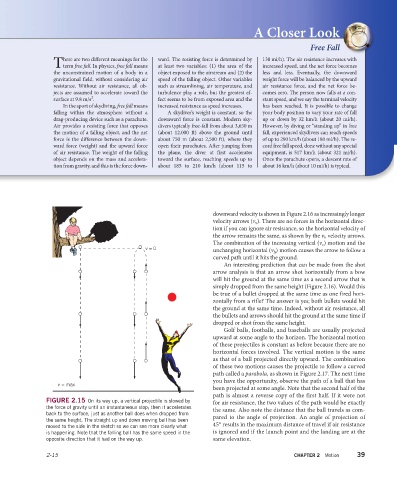
                       FIGURE 2.15  On its way up, a vertical projectile is slowed by   for air resistance, the two values of the path would be exactly
                       the force of gravity until an instantaneous stop; then it accelerates   the same. Also note the distance that the ball travels as com-
                       back to the surface, just as another ball does when dropped from
                                                                               pared to the angle of projection. An angle of projection of
                       the same height. The straight up and down moving ball has been
                       moved to the side in the sketch so we can see more clearly what   45° results in the maximum distance of travel if air resistance
                       is happening. Note that the falling ball has the same speed in the   is ignored and if the launch point and the landing are at the
                       opposite direction that it had on the way up.           same elevation.

                       2-15                                                                               CHAPTER 2  Motion   39

