


Page 60 - 9780077418427.pdf
P. 60
/Users/user-f465/Desktop
          tiL12214_ch02_025-060.indd Page 37  9/1/10  9:55 PM user-f465
          tiL12214_ch02_025-060.indd Page 37  9/1/10  9:55 PM user-f465                                                 /Users/user-f465/Desktop


                                                                                            A Closer Look


                                                                                                A Bicycle Racer’s Edge
                              alileo was one of the first to recognize                         likely to have the lower-pressure-producing
                          Gthe role of friction in opposing motion.                            air turbulence behind (and resulting greater
                          As shown in Figure 2.9, friction with the sur-                       pressure in front) because it smoothes, or
                          face and air friction combine to produce a                           streamlines, the air flow.
                          net force that works against anything that is                           The frictional drag of air is similar to
                          moving on the surface. This article is about                         the frictional drag that occurs when you
                          air friction and some techniques that bike                           push a book across a rough tabletop. You
                          riders use to reduce that opposing force—                            know that smoothing the rough tabletop
                          perhaps giving them an edge in a close race.                         will reduce the frictional drag on the book.
                             The bike riders in Box Figure 2.1 are                             Likewise, the smoothing of a surface ex-
                          forming a single-file line, called a  pace-  BOX FIGURE 2.1  The object of the race   posed to moving air will reduce air fric-
                          line, because the slipstream reduces the air   is to be in the front, to finish first. If this is   tion. Cyclists accomplish this “smoothing”
                            re sistance for a closely trailing rider. Cyclists   true, why are these racers forming a single-  by wearing smooth Lycra clothing and by
                                                            file line?
                          say that  riding in the slipstream of another                        shaving hair from arm and leg surfaces that
                          cyclist will save much of their energy. They                         are exposed to moving air. Each hair con-
                          can move 8 km/h faster than they would ex-                           tributes to the overall frictional drag, and
                          pending the same energy riding alone.  turbulent versus a smooth flow of air and   removal of the arm and leg hair can thus
                             In a sense, riding in a slipstream means   (2) the problem of frictional drag. A turbu-  result in seconds saved. This might provide
                          that you do not have to push as much air out   lent flow of air contributes to air resistance   enough of an edge to win a close race. Shav-
                          of your way. It has been estimated that at   because it causes the air to separate slightly   ing legs and arms and the wearing of Lycra
                          32 km/h, a cyclist must move a little less than   on the back side, which increases the pres-  or some other tight, smooth-fitting gar-
                          one-half a ton of air out of the way every   sure on the front of the moving object. This   ments are just a few of the things a cyclist
                          minute. Along with the problem of moving   is why racing cars, airplanes, boats, and   can do to gain an edge. Perhaps you will be
                          air out of the way, there are two basic fac-  other racing vehicles are streamlined to   able to think of more ways to reduce the
                          tors  related to air resistance. These are (1) a   a teardroplike shape. This shape is not as   forces that oppose  motion.


                           Galileo checked this calculation by rolling balls on an
                       inclined board with a smooth groove in it. He used the in-                                    9.8 m/s in 1 s
                       clined board to slow the motion of descent in order to measure
                       the distance and time relationships, a necessary requirement
                       since he lacked the accurate timing devices that exist today.                             19.6 m/s in 2 s
                       He found, as predicted, that the falling balls moved through a
                       distance proportional to the square of the time of falling. This
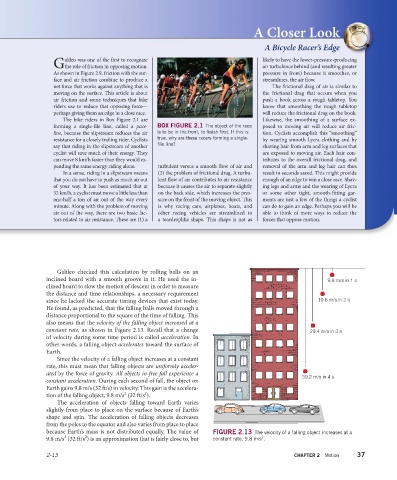
                       also means that the velocity of the falling object increased at a
                       constant rate, as shown in Figure 2.13. Recall that a change                            29.4 m/s in 3 s
                       of velocity during some time period is called acceleration. In
                       other words, a falling object accelerates toward the surface of
                       Earth.
                           Since the velocity of a falling object increases at a constant
                       rate, this must mean that falling objects are uniformly acceler-
                       ated by the force of gravity. All objects in free fall experience a
                                                                                                            39.2 m/s in 4 s
                       constant acceleration. During each second of fall, the object on
                       Earth gains 9.8 m/s (32 ft/s) in velocity. This gain is the accelera-
                                                        2
                                                 2
                       tion of the falling object, 9.8 m/s  (32 ft/s ).
                           The acceleration of objects falling toward Earth varies
                       slightly from place to place on the surface because of Earth’s
                       shape and spin. The acceleration of falling objects decreases
                       from the poles to the equator and also varies from place to place
                       because Earth’s mass is not distributed equally. The value of   FIGURE 2.13  The velocity of a falling object increases at a
                              2
                                    2
                                                                                               2
                        9.8 m/s  (32 ft/s ) is an approximation that is fairly close to, but   constant rate, 9.8 m/s .
                       2-13                                                                               CHAPTER 2  Motion   37

