


Page 63 - 9780077418427.pdf
P. 63
/Users/user-f465/Desktop
          tiL12214_ch02_025-060.indd Page 40  9/1/10  9:55 PM user-f465
          tiL12214_ch02_025-060.indd Page 40  9/1/10  9:55 PM user-f465                                                 /Users/user-f465/Desktop


                                                                       v h
                                                                                      v h
                                                                     v v

                                                                                                            v
                                                                                      v v                   h


                                                                                                           v v


                                                    v v


                                                    v v


                                                    v v


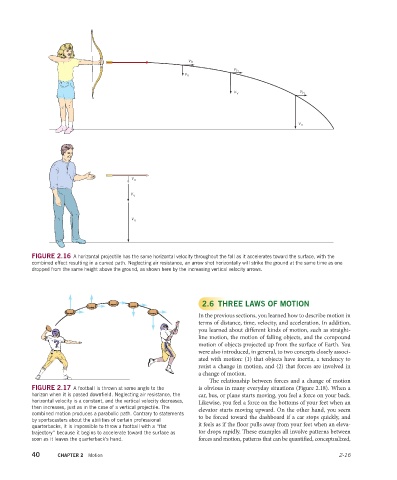
                   FIGURE 2.16  A horizontal projectile has the same horizontal velocity throughout the fall as it accelerates toward the surface, with the
                   combined effect resulting in a curved path. Neglecting air resistance, an arrow shot horizontally will strike the ground at the same time as one
                   dropped from the same height above the ground, as shown here by the increasing vertical velocity arrows.


                                                                           2.6  THREE LAWS OF MOTION
                                                                          In the previous sections, you learned how to describe motion in
                                                                          terms of distance, time, velocity, and acceleration. In addition,
                                                                          you learned about different kinds of motion, such as straight-
                                                                          line motion, the motion of falling objects, and the compound
                                                                          motion of objects projected up from the surface of Earth. You
                                                                          were also introduced, in general, to two concepts closely associ-
                                                                          ated with motion: (1) that objects have inertia, a tendency to
                                                                          resist a change in motion, and (2) that forces are involved in
                                                                          a change of motion.
                                                                             The relationship between forces and a change of motion
                   FIGURE 2.17  A football is thrown at some angle to the   is obvious in many everyday situations (Figure 2.18). When a
                   horizon when it is passed downfield. Neglecting air resistance, the   car, bus, or plane starts moving, you feel a force on your back.
                   horizontal velocity is a constant, and the vertical velocity decreases,   Likewise, you feel a force on the bottoms of your feet when an
                   then increases, just as in the case of a vertical projectile. The   elevator starts moving upward. On the other hand, you seem
                   combined motion produces a parabolic path. Contrary to statements
                                                                          to be forced toward the dashboard if a car stops quickly, and
                   by sportscasters about the abilities of certain professional
                   quarterbacks, it is impossible to throw a football with a “flat   it feels as if the floor pulls away from your feet when an eleva-
                   trajectory” because it begins to accelerate toward the surface as   tor drops rapidly. These examples all involve patterns between
                   soon as it leaves the quarterback’s hand.              forces and motion, patterns that can be quantified, conceptualized,

                   40      CHAPTER 2 Motion                                                                             2-16

