


Page 64 - 9780077418427.pdf
P. 64
/Users/user-f465/Desktop
          tiL12214_ch02_025-060.indd Page 41  9/1/10  9:55 PM user-f465
          tiL12214_ch02_025-060.indd Page 41  9/1/10  9:55 PM user-f465                                                 /Users/user-f465/Desktop


                                                                                            Original position
                                                                                            at rest


                                                                               A


                                                                                                         Original straight-line motion

                                                                                                                    Force by bus
                                                                                                                    changes your
                                                                                                                    motion
                       FIGURE 2.18  In a moving airplane, you feel forces in many
                        directions when the plane changes its motion. You cannot help but
                        notice the forces involved when there is a change of motion.
                                                                               B

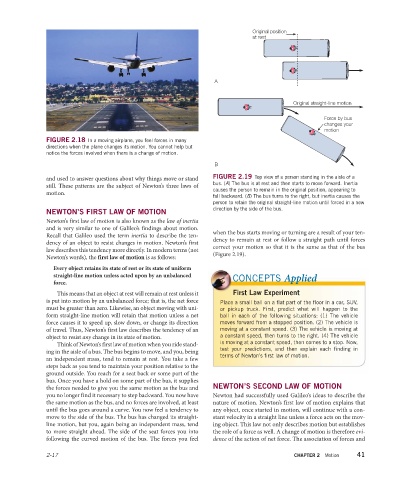
                       and used to answer questions about why things move or stand   FIGURE 2.19  Top view of a person standing in the aisle of a
                       still. These patterns are the subject of Newton’s three laws of   bus. (A) The bus is at rest and then starts to move forward. Inertia
                                                                               causes the person to remain in the original position, appearing to
                       motion.
                                                                               fall backward. (B) The bus turns to the right, but inertia causes the
                                                                               person to retain the original straight-line motion until forced in a new
                       NEWTON’S FIRST LAW OF MOTION                            direction by the side of the bus.
                       Newton’s first law of motion is also known as the law of inertia
                       and is very similar to one of Galileo’s findings about motion.
                                                                               when the bus starts moving or turning are a result of your ten-
                       Recall that Galileo used the term inertia to describe the ten-
                                                                               dency to  remain at rest or follow a straight path until forces
                       dency of an object to resist changes in motion. Newton’s first
                                                                               correct your motion so that it is the same as that of the bus
                       law describes this tendency more directly. In modern terms (not
                                                                               (Figure 2.19).
                       Newton’s words), the first law of motion is as  follows:
                          Every object retains its state of rest or its state of uniform
                          straight-line motion unless acted upon by an unbalanced    CONCEPTS Applied
                          force.

                           This means that an object at rest will remain at rest unless it   First Law Experiment
                       is put into motion by an unbalanced force; that is, the net force   Place a small ball on a flat part of the floor in a car, SUV,
                       must be greater than zero. Likewise, an object moving with uni-  or pickup truck. First, predict what will happen to the
                       form straight-line motion will retain that motion unless a net   ball in each of the following situations: (1) The vehicle
                       force causes it to speed up, slow down, or change its direction   moves forward from a stopped position. (2) The vehicle is
                       of travel. Thus, Newton’s first law describes the tendency of an   moving at a constant speed. (3) The vehicle is moving at
                         object to resist any change in its state of  motion.    a constant speed, then turns to the right. (4) The vehicle
                           Think of Newton’s first law of motion when you ride stand-  is moving at a constant speed, then comes to a stop. Now,
                                                                                 test your predictions, and then explain each  finding in
                       ing in the aisle of a bus. The bus begins to move, and you, being
                                                                                 terms of Newton’s first law of motion.
                       an independent mass, tend to remain at rest. You take a few
                       steps back as you tend to maintain your position relative to the
                       ground outside. You reach for a seat back or some part of the
                       bus. Once you have a hold on some part of the bus, it supplies
                       the forces needed to give you the same motion as the bus and   NEWTON’S SECOND LAW OF MOTION
                       you no longer find it necessary to step backward. You now have   Newton had successfully used Galileo’s ideas to describe the
                       the same motion as the bus, and no forces are involved, at least     nature of motion. Newton’s first law of motion explains that
                       until the bus goes around a curve. You now feel a tendency to   any object, once started in motion, will continue with a con-
                       move to the side of the bus. The bus has changed its straight-  stant  velocity in a straight line unless a force acts on the mov-
                       line motion, but you, again being an independent mass, tend   ing object. This law not only describes motion but establishes
                       to move straight ahead. The side of the seat forces you into   the role of a force as well. A change of motion is therefore evi-
                         following the curved motion of the bus. The forces you feel   dence of the  action of net force. The association of forces and

                       2-17                                                                               CHAPTER 2  Motion   41

