


Page 598 - 9780077418427.pdf
P. 598
/Volume/201/MHDQ233/tat78194_disk1of1/0073378194/tat78194_pagefiles
          tiL12214_ch23_565-596.indd Page 575  9/23/10  11:07 AM user-f465
          tiL12214_ch23_565-596.indd Page 575  9/23/10  11:07 AM user-f465             /Volume/201/MHDQ233/tat78194_disk1of1/0073378194/tat78194_pagefile


                        for increasing pressure, which means a high and its associated   or over flatlands from differential heating can move miles after
                        fair weather are coming. Consulting a daily weather map makes   they form, sometimes appearing to wander aimlessly across the
                        such projections a much easier job, however.           land. These storms are not just one big rain cloud but are some-
                                                                               times made up of cells that are born, grow to maturity, then die
                                                                               out in less than an hour. The thunderstorm, however, may last
                        MAJOR STORMS
                                                                               longer than an hour because new cells are formed as old ones
                        A wide range of weather changes can take place as a front passes
                                                                               die out. Each cell is about 2 to 8 km (about 1 to 5 mi) in diam-
                        because there is a wide range of possible temperature, moisture,
                                                                               eter and goes through three main stages in its life: (1) cumulus,
                        stability, and other conditions between the new air mass and the
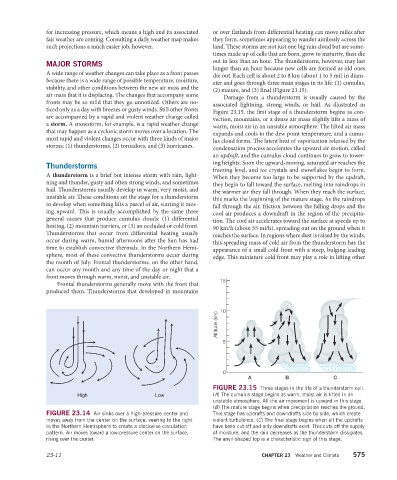
                                                                               (2) mature, and (3) final (Figure 23.15).
                        air mass that it is displacing. The changes that accompany some
                                                                                  Damage from a thunderstorm is usually caused by the
                        fronts may be so mild that they go unnoticed. Others are no-
                                                                                 associated lightning, strong winds, or hail. As illustrated in
                        ticed only as a day with breezes or gusty winds. Still other fronts
                                                                                 Figure 23.15, the first stage of a thunderstorm begins as con-
                        are accompanied by a rapid and violent weather change called
                                                                               vection, mountains, or a dense air mass slightly lifts a mass of
                        a storm. A snowstorm, for example, is a rapid weather change
                                                                               warm, moist air in an unstable atmosphere. The lifted air mass
                        that may happen as a cyclonic storm moves over a location. The
                                                                               expands and cools to the dew point temperature, and a cumu-
                        most rapid and violent changes occur with three kinds of major
                                                                               lus cloud forms. The latent heat of vaporization released by the
                        storms: (1) thunderstorms, (2) tornadoes, and (3) hurricanes.
                                                                               condensation process accelerates the upward air motion, called
                                                                               an updraft, and the cumulus cloud continues to grow to tower-
                                                                               ing heights. Soon the upward-moving, saturated air reaches the
                        Thunderstorms
                                                                               freezing level, and ice crystals and snowflakes begin to form.
                        A thunderstorm is a brief but intense storm with rain, light-
                                                                               When they  become too large to be supported by the updraft,
                        ning and thunder, gusty and often strong winds, and sometimes
                                                                               they begin to fall toward the surface, melting into raindrops in
                        hail. Thunderstorms usually develop in warm, very moist, and
                                                                               the warmer air they fall through. When they reach the surface,
                        unstable air. These conditions set the stage for a thunderstorm
                                                                               this marks the beginning of the mature stage. As the raindrops
                        to develop when something lifts a parcel of air, starting it mov-
                                                                               fall through the air, friction between the falling drops and the
                        ing upward. This is usually accomplished by the same three
                                                                               cool air produces a downdraft in the region of the precipita-
                        general causes that produce cumulus clouds: (1) differential
                                                                               tion. The cool air accelerates toward the surface at speeds up to
                        heating, (2) mountain barriers, or (3) an occluded or cold front.
                                                                               90 km/h (about 55 mi/h), spreading out on the ground when it
                        Thunderstorms that occur from differential heating usually
                                                                               reaches the surface. In regions where dust is raised by the winds,
                        occur during warm, humid afternoons after the Sun has had
                                                                               this spreading mass of cold air from the thunderstorm has the
                        time to establish convective thermals. In the Northern Hemi-
                                                                               appearance of a small cold front with a steep, bulging leading
                        sphere, most of these convective thunderstorms occur during
                                                                               edge. This miniature cold front may play a role in lifting other
                        the month of July. Frontal thunderstorms, on the other hand,
                        can occur any month and any time of the day or night that a
                        front moves through warm, moist, and unstable air.       15
                           Frontal thunderstorms generally move with the front that
                        produced them. Thunderstorms that developed in mountains
                                                                                 10
                                                                                Altitude (km)
                                                                                  5


                                                                                  0
                                                                                          A            B               C
                                                                               FIGURE 23.15  Three stages in the life of a thunderstorm cell.
                                  High                      Low                (A) The cumulus stage begins as warm, moist air is lifted in an
                                                                               unstable atmosphere. All the air movement is upward in this stage.
                                                                               (B) The mature stage begins when precipitation reaches the ground.
                        FIGURE 23.14  Air sinks over a high-pressure center and   This stage has updrafts and downdrafts side by side, which create
                       moves away from the center on the surface, veering to the right   violent turbulence. (C) The final stage begins when all the updrafts
                       in the Northern Hemisphere to create a clockwise circulation   have been cut off and only downdrafts exist. This cuts off the supply
                         pattern. Air moves toward a low-pressure center on the surface,   of moisture, and the rain decreases as the thunderstorm dissipates.
                       rising over the center.                                 The anvil-shaped top is a characteristic sign of this stage.

                        23-11                                                                  CHAPTER 23  Weather and Climate   575

