


Page 597 - 9780077418427.pdf
P. 597
/Volume/201/MHDQ233/tat78194_disk1of1/0073378194/tat78194_pagefile
          tiL12214_ch23_565-596.indd Page 574  9/23/10  11:07 AM user-f465
          tiL12214_ch23_565-596.indd Page 574  9/23/10  11:07 AM user-f465             /Volume/201/MHDQ233/tat78194_disk1of1/0073378194/tat78194_pagefiles


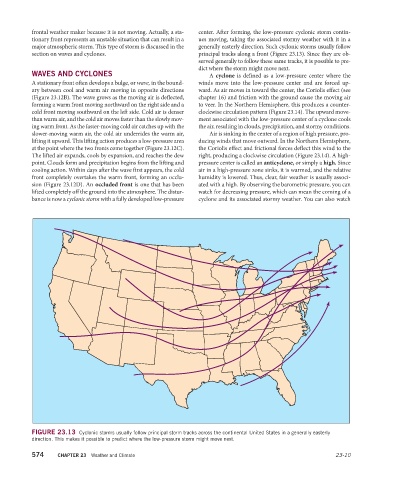
                   frontal weather maker because it is not moving. Actually, a sta-  center. After forming, the low-pressure cyclonic storm contin-
                   tionary front represents an unstable situation that can result in a   ues moving,  taking the associated stormy weather with it in a
                   major atmospheric storm. This type of storm is discussed in the   generally easterly direction. Such  cyclonic storms usually  follow
                   section on waves and cyclones.                         principal tracks along a front (Figure 23.13). Since they are ob-
                                                                          served generally to follow these same tracks, it is possible to pre-
                                                                          dict where the storm might move next.
                   WAVES AND CYCLONES                                         A cyclone is defined as a low-pressure center where the
                   A stationary front often develops a bulge, or wave, in the bound-  winds move into the low-pressure center and are forced up-
                   ary between cool and warm air moving in opposite directions   ward. As air moves in toward the center, the Coriolis effect (see
                   (Figure 23.12B). The wave grows as the moving air is deflected,   chapter 16) and friction with the ground cause the moving air
                   forming a warm front moving northward on the right side and a   to veer. In the Northern Hemisphere, this produces a counter-
                   cold front moving southward on the left side. Cold air is denser   clockwise circulation pattern (Figure 23.14). The upward move-
                   than warm air, and the cold air moves faster than the slowly mov-  ment  associated with the low-pressure center of a cyclone cools
                   ing warm front. As the faster-moving cold air catches up with the   the air, resulting in clouds, precipitation, and stormy  conditions.
                   slower-moving warm air, the cold air  underrides the warm air,   Air is sinking in the center of a region of high pressure, pro-
                   lifting it upward. This lifting action produces a  low-pressure area   ducing winds that move outward. In the Northern Hemisphere,
                   at the point where the two fronts come  together (Figure 23.12C).   the Coriolis effect and frictional forces deflect this wind to the
                   The lifted air expands, cools by expansion, and reaches the dew   right, producing a clockwise circulation (Figure 23.14). A high-
                   point. Clouds form and precipitation begins from the lifting and   pressure center is called an anticyclone, or simply a high. Since
                   cooling action. Within days after the wave first appears, the cold   air in a high-pressure zone sinks, it is warmed, and the relative
                   front completely overtakes the warm front, forming an occlu-  humidity is lowered. Thus, clear, fair weather is usually associ-
                   sion  (Figure 23.12D). An occluded front is one that has been   ated with a high. By observing the barometric pressure, you can
                   lifted completely off the ground into the  atmosphere. The distur-  watch for decreasing pressure, which can mean the coming of a
                   bance is now a cyclonic storm with a fully developed low- pressure   cyclone and its associated stormy weather. You can also watch


                   FIGURE 23.13  Cyclonic storms usually follow principal storm tracks across the continental United States in a generally easterly
                     direction. This makes it possible to predict where the low-pressure storm might move next.

                   574     CHAPTER 23  Weather and Climate                                                             23-10

