


Page 599 - 9780077418427.pdf
P. 599
/Volume/201/MHDQ233/tat78194_disk1of1/0073378194/tat78194_pagefiles
          tiL12214_ch23_565-596.indd Page 576  9/23/10  11:07 AM user-f465
          tiL12214_ch23_565-596.indd Page 576  9/23/10  11:07 AM user-f465             /Volume/201/MHDQ233/tat78194_disk1of1/0073378194/tat78194_pagefile


                   masses of warm, moist air in front of the thunderstorm, lead-  also adds to the rumbling sounds. The technique of calculat-
                   ing to the development of new cells. This stage in the life of a   ing the distance to a lightning stroke by measuring the interval
                   thunderstorm has the most intense rainfall, winds, and possibly   between the flash of the lightning and the boom of the thunder
                   hail. As the downdraft spreads throughout the cloud, the supply   is discussed in chapter 5. Lightning can present a risk for people
                   of new moisture from the updrafts is cut off and the thunder -  in the open, near bodies of water, or under a single,  isolated tree
                   storm enters the final, dissipating stage. The entire life cycle,   during a thunderstorm. The safest place to be during a thunder-
                   from cumulus cloud to the  final stage, lasts for about an hour as   storm is inside a car or a building with a metal frame.
                   the thunderstorm moves across the surface. During the mature   Updrafts are also responsible for hail, a frozen form of pre-
                   stage of powerful updrafts, the top of the thunderstorm may   cipitation that can be very destructive to crops, automobiles, and
                   reach all the way to the top of the troposphere, forming a cirrus   other property. Hailstones can be irregular, somewhat spherical,
                   cloud that is spread into an anvil shape by the strong winds at   or flattened forms of ice that range from the size of a BB to the
                   this high altitude.                                    size of a softball (Figure 23.17). Most hailstones, however, are
                      The updrafts, downdrafts, and falling precipitation sepa-  less than 2 cm (about 1 in) in diameter. The larger hailstones
                   rate tremendous amounts of electric charges that accumulate in   have alternating layers of clear and opaque, cloudy ice. These
                   different parts of the thundercloud. Large drops of water tend   layers are believed to form as the hailstone goes through cycles
                   to carry negative charges, and cloud droplets tend to lose them.   of falling then being returned to the upper parts of the thunder-
                   The upper part of the thunderstorm develops an accumula-    cloud by updrafts. The clear  layers are believed to form as the
                   tion of positive charges as cloud droplets are uplifted, and the   hailstone moves through heavy layers of supercooled  water
                   middle portion  develops an accumulation of negative charges   droplets, which accumulate quickly on the hailstone but freeze
                   from larger drops that fall. There are many other charging pro-  slowly because of the release of the latent heat of fusion. The
                   cesses at work, and the lower part of the thundercloud develops   cloudy layers are believed to form as the hailstone accumulates
                   both negative and positive charges. The voltage of these charge   snow crystals or moves through a part of the cloud with less
                   centers builds to the point that the electrical insulating abil-    supercooled water droplets. In either case, rapid freezing traps
                   ity of the air between them is overcome and a giant electrical   air bubbles, which result in the opaque, cloudy layer. Thunder-
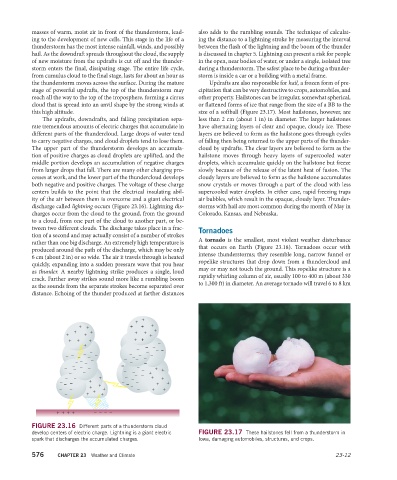
                   discharge called lightning occurs (Figure 23.16). Lightning dis-  storms with hail are most common during the month of May in
                   charges occur from the cloud to the ground, from the ground   Colorado, Kansas, and Nebraska.
                   to a cloud, from one part of the cloud to another part, or be-
                   tween two different clouds. The discharge takes place in a frac-  Tornadoes
                   tion of a second and may actually consist of a number of strokes
                                                                          A  tornado is the smallest, most violent weather disturbance
                   rather than one big  discharge. An extremely high tem perature is
                                                                          that occurs on Earth (Figure 23.18). Tornadoes occur with
                   produced around the path of the discharge, which may be only
                                                                          intense thunderstorms; they resemble long, narrow funnel or
                   6 cm (about 2 in) or so wide. The air it travels through is heated
                                                                          ropelike structures that drop down from a thundercloud and
                   quickly, expanding into a sudden pressure wave that you hear
                                                                          may or may not touch the ground. This ropelike structure is a
                   as thunder. A nearby lightning strike produces a single, loud
                                                                          rapidly whirling column of air, usually 100 to 400 m (about 330
                   crack. Farther away strikes sound more like a rumbling boom
                                                                          to 1,300 ft) in diameter. An average tornado will travel 6 to 8 km
                   as the sounds from the separate strokes become separated over
                   distance. Echoing of the thunder produced at farther distances
                                                     +  +
                                  +  +             +   +  +
                                 +    +              +  +  +
                              +     +                     +
                               +  +   +              +  +
                                    +                   – –  –
                                                     –   –  –  –
                                      –
                              – –  –  –  –  –      – –  –  –  –
                                 –  –  –  –      –  –  –  –
                              –  – –  –  –      –     –  –  + +
                               –    –            –  – – –  +
                              –  –       +        –  –    +   +
                            –  –  –   +  +       –  –  –    +  +
                            –  –      + +  +       –  –   +   +
                              –      +    +


                           +  +  +  +  –  –  –  –

                   FIGURE 23.16  Different parts of a thunderstorm cloud
                     develop centers of electric charge. Lightning is a giant electric   FIGURE 23.17  These hailstones fell from a thunderstorm in
                   spark that discharges the accumulated charges.         Iowa, damaging automobiles, structures, and crops.

                   576     CHAPTER 23  Weather and Climate                                                             23-12

