


Page 65 - 9780077418427.pdf
P. 65
/Users/user-f465/Desktop
          tiL12214_ch02_025-060.indd Page 42  9/1/10  9:55 PM user-f465
          tiL12214_ch02_025-060.indd Page 42  9/1/10  9:55 PM user-f465                                                 /Users/user-f465/Desktop


                   a change of motion is common in your everyday experience. You
                   have felt forces on your back in an accelerating automobile, and
                   you have felt other forces as the automobile turns or stops. You
                   have also learned about gravitational forces that accelerate ob-
                   jects toward the surface of Earth. Unbalanced forces and accel-
                   eration are involved in any change of motion. Newton’s second
                   law of motion is a relationship between net force, acceleration,
                   and mass that describes the cause of a change of motion.
                      Consider the motion of you and a bicycle you are riding.
                   Suppose you are riding your bicycle over level ground in a straight
                   line at 10 miles per hour. Newton’s first law tells you that you will
                   continue with a constant velocity in a straight line as long as no
                   external, unbalanced force acts on you and the  bicycle. The force
                   that you are exerting on the pedals seems to equal some external
                   force that moves you and the bicycle along (more on this later).
                   The force exerted as you move along is needed to balance the
                   resisting forces of tire friction and air  resistance. If these resisting
                   forces were removed, you would not need to exert any force at all
                   to continue moving at a constant velocity. The net force is thus
                   the force you are applying minus the forces from tire friction and
                   air resistance. The net force is therefore zero when you move at a
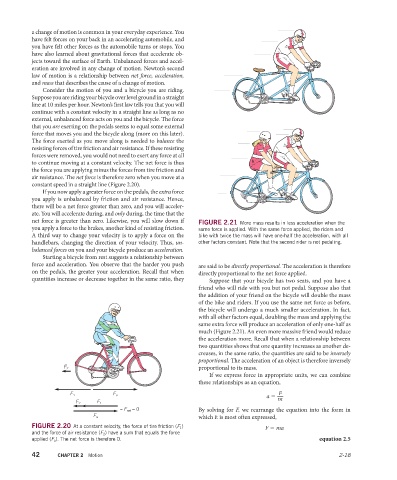
                   constant speed in a straight line (Figure 2.20).
                      If you now apply a greater force on the pedals, the extra force
                   you apply is unbalanced by friction and air resistance. Hence,
                   there will be a net force greater than zero, and you will acceler-
                   ate. You will accelerate during, and only during, the time that the
                   net force is greater than zero. Likewise, you will slow down if   FIGURE 2.21  More mass results in less acceleration when the
                   you  apply a force to the brakes, another kind of resisting friction.   same force is applied. With the same force applied, the riders and
                   A third way to change your velocity is to apply a force on the   bike with twice the mass will have one-half the acceleration, with all
                   handlebars, changing the direction of your velocity. Thus, un-  other factors constant. Note that the second rider is not pedaling.
                   balanced forces on you and your bicycle produce an  acceleration.
                      Starting a bicycle from rest suggests a relationship between
                   force and acceleration. You observe that the harder you push   are said to be directly proportional. The acceleration is therefore
                   on the pedals, the greater your acceleration. Recall that when     directly proportional to the net force applied.
                   quantities increase or decrease together in the same ratio, they   Suppose that your bicycle has two seats, and you have a
                                                                          friend who will ride with you but not pedal. Suppose also that
                                                                          the addition of your friend on the bicycle will double the mass
                                                                          of the bike and riders. If you use the same net force as before,
                                                                          the bicycle will undergo a much smaller acceleration. In fact,
                                                                          with all other factors equal, doubling the mass and applying the
                                                                          same extra force will produce an acceleration of only one-half as
                                                                          much (Figure 2.21). An even more massive friend would reduce
                                                                          the acceleration more. Recall that when a relationship between
                                                                          two quantities shows that one quantity increases as another de-
                                                                          creases, in the same ratio, the quantities are said to be inversely
                                                                          proportional. The acceleration of an object is therefore inversely
                             F 2                                          proportional to its mass.
                                                                             If we express force in appropriate units, we can combine
                                                                          these relationships as an equation,
                                                                                                    F _

                                                                                                a =
                               F 1            F a
                                                                                                    m
                                 F 2    F 1
                                                = F net  = 0              By solving for F, we rearrange the equation into the form in
                                                                          which it is most often expressed,
                                       F a
                   FIGURE 2.20  At a constant velocity, the force of tire friction (F 1 )       F = ma
                   and the force of air resistance (F 2 ) have a sum that equals the force
                   applied (F a ). The net force is therefore 0.                                                  equation 2.5
                   42      CHAPTER 2 Motion                                                                             2-18

