


Page 9 - Pavimenti cosmateschi _Neat
P. 9
WESTMINSTER ABBEY in LONDON


         The Cosmati were a Roman family, seven members of which, for four generations, were skillful architects, sculptors and workers in decorative
         geometric mosaic, mostly for church floors. Their name is commemorated in the genre of Cosmatesque work, often just called "Cosmati". The
         chief signed works by Jacopo the younger and his brother Luca is at Anagni. In the crypt at Anagni is the largest section of undisturbed Cosmatesque
         flooring. Cosmatesque decoration is not entirely confined to Rome, or even to Italy. At Westminster Abbey, there are two Cosmatesque pavements,
         the finest north of the Alps set in Purbeck Marble: one is the Great Pavement before the high altar, the other the paving and decor associated with the
         between each rectangle. No two roundels are the same. In detail, the variations of the pattern are virtually endless.
         shrine of Edward the Confessor in the Sanctuary. The design itself has a broad border, with a rectangle in the middle of each side and five roundels

                                                       The inspiration for the Cosmati pavement at Westminster Abbey is usually credited
                                                       to Richard de Ware, who was buried beneath the pavement.
                                                       In 1258 the newly elected Abbot of Westminster, Richard de Ware, left for Italy for
                                                       confirmation of his office by the Pope. The Papal court, at that time, was at Anagni.
             General   Description                     Here, or so the theory goes, he was impressed by the cosmati-style mosaic pavement
                                                       of the cathedral and conceived the possibility that his own abbey church might be
                                                       similarly beautified.
                                                       “…. saw the stunning mosaic pavements”
                                                       “…On the floor of the Nave of Anagni Cathedral was a work of Art that reflected this faith in the order of the
                                                       world: a pavement of intricate patterns, roundels, circles, hexagons, a continuous flow of quincunx, symbols -
                                                       shapes…..”
                                                       Ware revisited the papal court in early 1260 and again in early 1261, when he is likely
                                                       to have commissioned Italian marble workers – including Odoricus (named in the
                                                       pavement’s inscription) to visit England and decorate Henry III’s new abbey church.
                                                       “Henry III’s commissioning of the pavement can be seen as a reassertion of the divine right of kings - a riposte
                                                       to Simon de Monfort - other rebellious barons”.
                                                        http://www.westminster-abbey.org/conservation/interactive-map

                                                                     Tombs  -  Ware and Wenlock
                   The  Westminster  sanctuary  pavement  was        These  two  tombs  contain  the  only  existing  burials  in  the
                   substantially completed in 1268, the year before   pavement and form part of the original scheme dating from
                   Edward the Confessor’s relics were translated     1268. On the north side of the pavement is the burial of Abbot
                   to  their  new  shrine.  The  cosmati  work  at   Richard de Ware, Abbot of Westminster from 1258 until his
                   Westminster  also  included  the  base  of  Saint   death in 1283.. On the south side of the pavement lies the tomb
                                                                     of  Abbot  Walter  de  Wenlock,  Ware's  successor,  who  died  in
                   Edward’s shrine, its altar and the paving around     Central Roundel
                                                                     1307.
                   it, and several tombs, including that of Henry
             Materials   around  1278-9,  although  the  preservation  of   The   Central
                   III himself for which Italian craftsmen returned
                   these is only fragmentary.
                                                                       Roundel is part
                   The  great  pavement  is  24  feet  10  inches  (7
                                                                       of  the  original
                   meters 58 centimeters) square, and consists of
                                                                       scheme  dating
                   geometrical  patterns  built  up  from  pieces  of
                                                                       from 1268. This
                   stone  of  different  colors  and  sizes  cut  into  a
                                                                       stone  roundel
                   variety  of  shapes:  triangles,  squares,  circles,
                                                                       was  obviously
                   rectangles  and  many  others.  The  central
                   roundel is made of onyx and the pavement also
                                                       It is at the very heart of the pavement
                   includes purple porphyry, green serpentine and   chosen for its spectacular appearance.
                                                       and is thought to represent the earth at
                   yellow limestone.                   the centre of the universe. The stone is
                   The  geometric  framework  of  the  pavement  is   a travertine calcium carbonate known
                   made from Purbeck Marble. It is unique to find   as  Alabastro  fiorito,  a  fresh  water
                   Purbeck  Marble  used  as  the  framework  for  a   limestone from hot spring deposits and
                   Cosmati  floor.  In  Italy  the  framework  for   from the Roman site of Pamukkale in
                   Cosmati work is always a white marble.    Turkey.

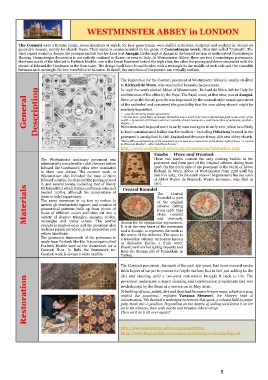
                                                       The Cosmati pavement, for most of the past 150 years, has been covered under
                                                       thick layers of carpet to protect its fragile surface, but in fact just adding to the
             Restoration                               re-dedicated by the Dean at a service on 21 May 2010.
                                                       dirt  and  staining  until  a  two-year  restoration  brought  it  back  to  life.  The
                                                       pavement undergone a major cleaning and conservation programme and was
                                                       ‘A build-up of wax, polish, dirt and dust had become a brown mass, which in a way
                                                       unified  the  pavement,’  explains  Vanessa  Simeoni,  the  Abbey's  head  of
                                                       conservation, ‘We devised a technique to remove this gunk, a solvent held in paper
                                                       pulp made into a poultice. Depending on the degree of soiling we’d leave it on for
                                                       20 to 60 minutes, then with swabs and brushes take it all up.
                                                       Then we’d do it all over again!’

                                                       http://www.westminster-abbey.org/conservation
                                                       https://www.theguardian.com/science/2008/may/05/archaeology.art


                                                                                                   8

