


Page 8 - Pavimenti cosmateschi _Neat
P. 8
“SANTA MARIA ANNUNZIATA”   in  ANAGNI


                                                                  Cosmati  mosaic  is  a  type  of  mosaic  technique  that  was
                                                                  practiced by decorators in the 12th and 13th centuries, in which
          General   Description                                   tiny triangles and squares of colored stone (red porphyry, green
                                                                  serpentine,  and  white  and  other  colored  marbles)  and  glass
                                                                  paste were arranged in patterns and combined with large, stone
                                                                  disks and strips to produce geometric designs.
                                                                  This  style  of  ornamental  mosaic  was  introduced  into  the
                                                                  decorative  art  of  Europe,  by  a  marble-worker  named
                                                                  Laurentius, a native of Anagni, a small hill-town thirty-seven
                                                                 miles east-south-east of Rome.

                                                                  The stone used by the Cosmati artists were salvaged material
                                                                  from the ruins of ancient Roman buildings, the large roundels
              Materials                                           The Cosmati made extensive use of red and green porphyry for
                                                                  being the carefully cut cross sections of Roman columns.
                                                                  the  floors,  which  came  from  marble  columns  dating  from
                                                                  antiquity, cut in such a way as to produce circles and squares.
                                                                  These geometric shapes would then have been arranged on the
                                                                  floor in a frame of white marble which, in turn, consisted of
                                                                  triangles, stars, lozenges and circles composed of multicolored

                                                                  marble tiles.

                 The  treasury  is  housed  in  a
                 medieval chapel (c.1105) with
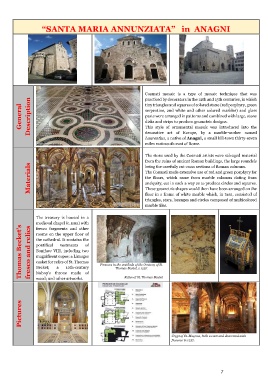
          Thomas Becket’s    fresco and relics   rooms  on  the  upper  floor  of   Frescoes in the vestibule of the Oratory of St.
                 fresco  fragments  and  other

                 the cathedral. It contains the
                            vestments
                                       of
                 pontifical
                 Boniface  VIII,  including  two
                 magnificent copes; a Limoges
                 casket for relics of St. Thomas
                              12th-century
                 Becket;
                          a
                                                    Thomas Becket, c.1237.
                 bishop's  throne  made  of
                                                        Relics of St. Thomas Becket
                 wood; and other artworks.


          Pictures


                                                                             Crypt of St. Magnus, built c.1100 and decorated with
                                                                             frescoes in 1237.


                                                                                                   7

