


Page 123 - Learn To Program With Scratch
P. 123
Data t yPe of a VariaBLe
                             At this point, you might wonder, “How does Scratch know the data type of a
                             variable?” The answer is, it doesn’t! When you create a variable, Scratch has
                             no idea whether you intend to use that variable to store to a number, a string,
                             or a Boolean . Any variable can hold a value of any data type . For example,
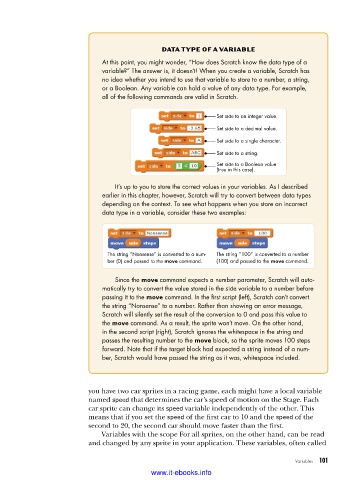
                             all of the following commands are valid in Scratch .


                                                             Set side to an integer value.
                                                             Set side to a decimal value.
                                                             Set side to a single character.

                                                             Set side to a string.

                                                             Set side to a Boolean value
                                                             (true in this case).
                                 It’s up to you to store the correct values in your variables . As I described
                             earlier in this chapter, however, Scratch will try to convert between data types
                             depending on the context . To see what happens when you store an incorrect
                             data type in a variable, consider these two examples:


                               The string “Nonsense” is converted to a num-  The string “100” is converted to a number
                               ber (0) and passed to the move command.  (100) and passed to the move command.

                                 Since the move command expects a number parameter, Scratch will auto-
                             matically try to convert the value stored in the side variable to a number before
                             passing it to the move command . In the first script (left), Scratch can’t convert
                             the string “Nonsense” to a number . Rather than showing an error message,
                             Scratch will silently set the result of the conversion to 0 and pass this value to
                             the move command . As a result, the sprite won’t move . On the other hand,
                             in the second script (right), Scratch ignores the whitespace in the string and
                             passes the resulting number to the move block, so the sprite moves 100 steps
                             forward . Note that if the target block had expected a string instead of a num-
                             ber, Scratch would have passed the string as it was, whitespace included .


                          you have two car sprites in a racing game, each might have a local variable
                          named speed that determines the car’s speed of motion on the Stage. Each
                          car sprite can change its speed variable independently of the other. This
                          means that if you set the speed of the first car to 10 and the speed of the
                            second to 20, the second car should move faster than the first.
                             Variables with the scope For all sprites, on the other hand, can be read
                          and changed by any sprite in your application. These variables, often called

                                                                                   Variables   101

                                           www.it-ebooks.info

