


Page 132 - Learn To Program With Scratch
P. 132
try it out 5-3
                            Open the Ohm’s law simulator to run it, and study the scripts to understand how
                            it works . What do you think would happen if you added the command change
                            color effect by 25 at the end of the script for the Light sprite? Implement this
                            change to check your answer . What are some ways you could enhance this
                            application?


                         Demonstrating a Series Circuit
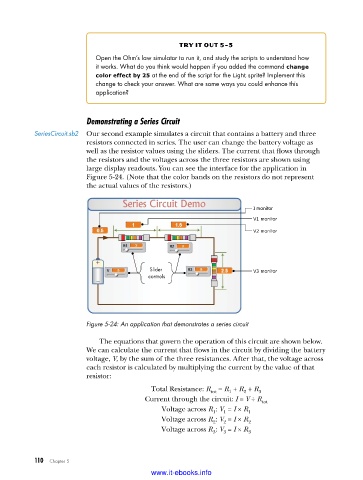
           SeriesCircuit .sb2  Our second example simulates a circuit that contains a battery and three
                         resistors connected in series. The user can change the battery voltage as
                         well as the resistor values using the sliders. The current that flows through
                         the resistors and the voltages across the three resistors are shown using
                         large display readouts. You can see the interface for the application in
                         Figure 5-24. (Note that the color bands on the resistors do not represent
                         the actual values of the resistors.)


                                                                       I monitor
                                                                                                                                                        try it out 5-4
                                                                       V1 monitor
                                                                                                                   SeriesCircuit   Open the series circuit simulator application and run it . Experiment with different
                                                                       V2 monitor                                WithSwitch .sb2  values of R1, R2, R3, and V . Watch the calculated values of V1, V2, and V3 as
                                                                                                                                 you drag the slider controls . What is the relationship between the voltage sum
                                                                                                                                 (V1 + V2 + V3) and the battery voltage? What does this tell you about the voltage
                                                                                                                                 relation in series circuits? You can make an interesting enhancement to the appli-
                                           Slider                      V3 monitor                                                cation by adding an image of a switch that opens or closes the circuit, as shown
                                          controls                                                                               below . When the switch is open, no current will flow in the circuit . Try to imple-
                                                                                                                                 ment this change using the hints given below .

                                                                                                                                                                               Script for the
                                                                                                                                                                               Switch sprite

                         Figure 5-24: An application that demonstrates a series circuit                                                                        Change how the main script calculates the current (I).
                             The equations that govern the operation of this circuit are shown below.                                                                             Same as before
                         We can calculate the current that flows in the circuit by dividing the battery                                  Switch sprite has
                                                                                                                                          two costumes
                         voltage, V, by the sum of the three resistances. After that, the voltage across                                   (On, Off).                        Switch if Off. Set current to 0.
                         each resistor is calculated by multiplying the current by the value of that
                         resistor:

                                           Total Resistance: R  = R  + R  + R 3
                                                                     2
                                                                 1
                                                            tot
                                         Current through the circuit: I = V ÷ R tot
                                              Voltage across R : V  = I × R 1
                                                            1
                                                               1
                                              Voltage across R : V  = I × R 2
                                                               2
                                                            2
                                              Voltage across R : V  = I × R 3
                                                               3
                                                            3
           110   Chapter 5
                                           www.it-ebooks.info

