


Page 734 - MARSIUM'21 COMP OF PAPER
P. 734
713
            RESEARCH FRAMEWORK MODEL


                         Characters archetype (H1)


                             Storytelling (H2)                             Young People’s Behavior


                            Language Used (H3)


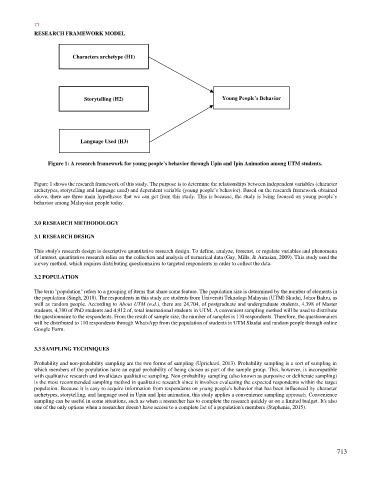
                 Figure 1: A research framework for young people’s behavior through Upin and Ipin Animation among UTM students.


            Figure 1 shows the research framework of this study. The purpose is to determine the relationships between independent variables (character
            archetypes, storytelling and language used) and dependent variable (young people’s behavior). Based on the research framework obtained
            above, there are three main hypotheses that we can get from this study. This is because, the study is being focused on young people’s
            behavior among Malaysian people today.


            3.0 RESEARCH METHODOLOGY

            3.1 RESEARCH DESIGN

            This study's research design is descriptive quantitative research design. To define, analyze, forecast, or regulate variables and phenomena
            of interest, quantitative research relies on the collection and analysis of numerical data (Gay, Mills, & Airasian, 2009). This study used the
            survey method, which requires distributing questionnaires to targeted respondents in order to collect the data.

            3.2 POPULATION

            The term "population" refers to a grouping of items that share some feature. The population size is determined by the number of elements in
            the population (Singh, 2018). The respondents in this study are students from Universiti Teknologi Malaysia (UTM) Skudai, Johor Bahru, as
            well as random people. According to About UTM (n.d.), there are 24,704, of postgraduate and undergraduate students, 4,398 of Master
            students, 4,780 of PhD students and 4,912 of, total international students in UTM. A convenient sampling method will be used to distribute
            the questionnaire to the respondents. From the result of sample size, the number of samples is 110 respondents. Therefore, the questionnaires
            will be distributed to 110 respondents through WhatsApp from the population of students in UTM Skudai and random people through online
            Google Form.


            3.3 SAMPLING TECHNIQUES

            Probability and non-probability sampling are the two forms of sampling (Uprichard, 2013). Probability sampling is a sort of sampling in
            which members of the population have an equal probability of being chosen as part of the sample group. This, however, is incompatible
            with qualitative research and invalidates qualitative sampling. Non-probability sampling (also known as purposive or deliberate sampling)
            is the most recommended sampling method in qualitative research since it involves evaluating the expected respondents within the target
            population. Because it is easy to acquire information from respondents on young people's behavior that has been influenced by character
            archetypes, storytelling, and language used in Upin and Ipin animation, this study applies a convenience sampling approach. Convenience
            sampling can be useful in some situations, such as when a researcher has to complete the research quickly or on a limited budget. It's also
            one of the only options when a researcher doesn't have access to a complete list of a population's members (Stephanie, 2015).


                                                                                                                 713

