


Page 103 - Engineering Mathematics Workbook_Final
P. 103
Differential Equations & Partial Differential Equations
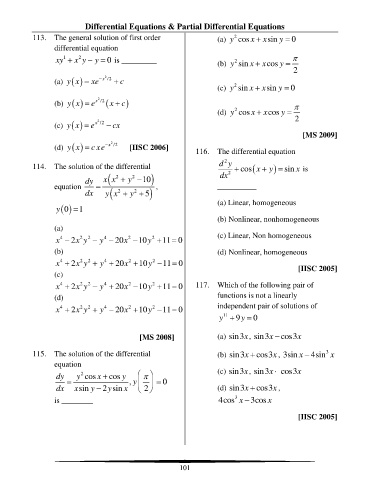
113. The general solution of first order (a) y 2 cos x + x sin y = 0
differential equation
xy + x y − = 0 is _________ 2
2
1
y
+
(b) y sin x x cos y =
2
(a) ( ) x = y xe − x 2 /2 + c
(c) y 2 sin x + x sin y = 0
(b) ( ) x = y e x 2 /2 (x c+ )
(d) y 2 cos x + x cos y = 2
(c) ( ) x = y e x 2 /2 − cx
[MS 2009]
y
(d) ( ) x = c xe − x 2 /2 [IISC 2006]
116. The differential equation
2
114. The solution of the differential d y + cos (x + y =
) sin x is
2
dy ( x x + 2 y − 2 10 ) dx
equation = , __________
dx ( y x + 2 y + 2 ) 5
(a) Linear, homogeneous
1
y ( ) 0 =
(b) Nonlinear, nonhomogeneous
(a)
2
2
=
4
2
x − 2x y − y − 20x − 10y + 11 0 (c) Linear, Non homogeneous
2
4
(b) (d) Nonlinear, homogeneous
2
4
2
=
4
x + 2x y + y + 20x + 10y − 11 0
2
2
(c) [IISC 2005]
=
x + 2x y − y + 20x − 10y + 11 0 117. Which of the following pair of
4
2
4
2
2
2
(d) functions is not a linearly
x + 2x y + y − 20x + 10y − 11 0 independent pair of solutions of
=
2
2
4
4
2
2
y + 11 9y = 0
[MS 2008] (a) sin3x, sin3x − cos3x
3
115. The solution of the differential (b) sin3x + cos3x , 3sin x − 4sin x
equation
dy = y 2 cos x + cos y , y = 0 (c) sin3x, sin3x cos3x
y
dx x sin y − 2 sin x 2 (d) sin3x + cos3x ,
3
is ________ 4cos x − 3cosx
[IISC 2005]
101

