Page 101 - Engineering Mathematics Workbook_Final
P. 101
Differential Equations & Partial Differential Equations

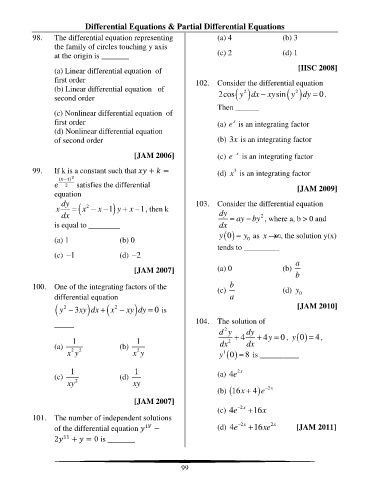
            98.    The differential equation representing                (a) 4                 (b) 3
                   the family of circles touching y axis
                   at the origin is _______                              (c) 2                 (d) 1

                   (a) Linear differential equation  of                                             [IISC 2008]
                   first order
                                                                  102.  Consider the differential equation
                   (b) Linear differential equation   of                          2                2
                                                                                                ( ) dy =
                                                                               ( ) dx xy
                   second order                                          2cos y        −    sin y          0.
                                                                         Then ______
                       (c) Nonlinear differential equation  of
                   first order
                                                                              x
                                                                         (a) e  is an integrating factor

                   (d) Nonlinear differential equation
                   of second order                                       (b) 3x is an integrating factor
                                                                              −
                                                                               x
                                             [JAM 2006]                  (c) e  is an integrating factor
            99.    If k is a constant such that      +    =              (d)  x  is an integrating factor
                                                                              3
                    (  −1) 2
                       2  satisfies the differential                                               [JAM 2009]
                   equation
                     dy                                           103.  Consider the differential equation
                              2
                                            x
                                 x
                    x    = ( x − −    ) 1 y + − 1, then k
                     dx                                                   dy  =  ay by , where a, b > 0 and
                                                                                  −
                                                                                       2
                   is equal to ________                                   dx
                                                                          y ( ) 0 =  y  as  x →  , the solution y(x)
                   (a) 1                 (b) 0                                     0
                                                                         tends to _________
                                             −
                       −
                   (c)  1                (d)  2
                                                                                                   a
                                             [JAM 2007]                  (a) 0                 (b)
                                                                                                   b
            100.  One of the integrating factors of the                  (c)   b               (d)  y
                   differential equation                                     a                      0

                   ( y −  3xy ) dx + ( x −  xy ) dy =  0 is                                        [JAM 2010]
                                       2
                      2
                   _____                                          104.  The solution of
                                                                           2
                                                                          d y      dy
                                                                                              0 y
                                                                                                         4
                         1                    1                           dx 2  +  4  dx  +  4y = ,  ( ) 0 = ,
                   (a)                   (b)
                                              2
                         2
                       x y 2                 x y                          y 1 ( ) 0 =  is __________
                                                                                  8
                        1                    1                                  2x
                   (c)                   (d)                             (a) 4e
                       xy 2                  xy
                                                                         (b) (16x +   ) 4 e − 2x
                                             [JAM 2007]
                                                                         (c) 4e − 2x  + 16x
            101.  The number of independent solutions
                                                                                           2x
                   of the differential equation    1    −                (d) 4e − 2x  + 16xe          [JAM 2011]
                   2   11  +    = 0 is _______


                                                             99
   96   97   98   99   100   101   102   103   104   105   106