


Page 145 - Engineering Mathematics Workbook_Final
P. 145
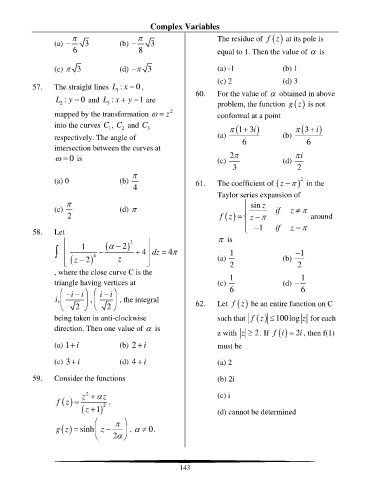
Complex Variables
The residue of ( ) z at its pole is
f
(a) − 3 (b) − 3
6 8 equal to 1. Then the value of is
−
(c) 3 (d) 3 (a) -1 (b) 1
(c) 2 (d) 3
0
:
57. The straight lines L x = ,
1
L 2 : y = and L x + : y = 1 are 60. For the value of obtained in above
0
g
problem, the function ( ) z is not
3
mapped by the transformation = z conformal at a point
2
into the curves C , C and C (1 3i ) (3 i + )
+
3
1
2
respectively. The angle of (a) 6 (b) 6
intersection between the curves at
= 0 is (c) 2 (d) i
3 2
(a) 0 (b) 61. The coefficient of (z ) in the
2
−
4
Taylor series expansion of
sin z
(c) (d) if z
z
2 f ( ) z = − around
=
58. Let − 1 if z
2 is
1 − ( − ) 2 + 4 dz = 4 1 − 1
(z − ) 2 4 z (a) 2 (b) 2
, where the close curve C is the 1 1
triangle having vertices at (c) (d) −
− i i − i i − 6 6
,
, i , the integral f
2 2 62. Let ( ) z be an entire function on C
being taken in anti-clockwise such that ( ) z 100log z for each
f
direction. Then one value of is
f i =
2
z with z . If ( ) 2i , then f(1)
(a) 1 i+ (b) 2 i+ must be
(c) 3 i+ (d) 4 i+ (a) 2
59. Consider the functions (b) 2i
z + z (c) i
2
f ( ) z = 2 ,
(z + ) 1 (d) cannot be determined
g ( ) sinhz = z − , 0.
2
143

