


Page 150 - Engineering Mathematics Workbook_Final
P. 150
Complex Variables
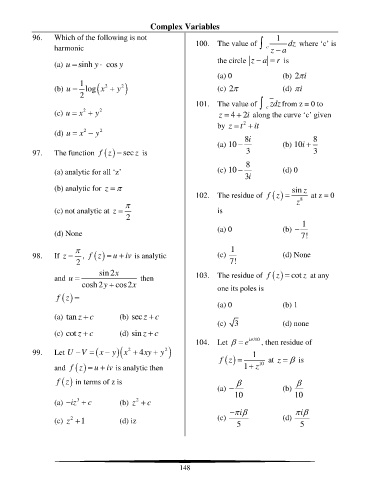
96. Which of the following is not c 1
harmonic 100. The value of z a dz where ‘c’ is
−
−
(a) u = sinh y cos y the circle z a = r is
(a) 0 (b) 2 i
1
(b) u = log ( x + 2 y 2 ) (c) 2 (d) i
2
101. The value of c zdz from z = 0 to
2
(c) u = x + 2 y z = 4 2i along the curve ‘c’ given
+
=
by z t + 2 it
2
(d) u = x − 2 y 8i 8
(a) 10 − (b) 10i +
97. The function ( ) secf z = z is 3 3
8
(a) analytic for all ‘z’ (c) 10 − (d) 0
3i
=
(b) analytic for z sin z
102. The residue of ( ) z = at z = 0
f
z 8
(c) not analytic at z = is
2
(a) 0 (b) − 1
(d) None 7!
1
+
f
98. If z = , ( ) z = u iv is analytic (c) (d) None
2 7!
sin2x f z =
and u = then 103. The residue of ( ) cot z at any
cosh2y + cos2x one its poles is
f ( ) z =
(a) 0 (b) 1
(a) tan z c+ (b) secz c+
(c) 3 (d) none
+
+
(c) cot z c (d) sin z c
104. Let = e i /10 , then residue of
−
2
99. Let U V = (x − y )( x + 4xy + y 2 ) 1
=
f ( ) z = at z is
+
+
and ( ) z = u iv is analytic then 1 z 10
f
f ( ) z in terms of z is
(a) − (b)
10 10
2
c
(a) iz− 3 + c (b) z +
i − i
2
(c) z + 1 (d) iz (c) 5 (d) 5
148

