


Page 84 - Digital Electronics by harish
P. 84
3.2  Counters

                       The most important sequential circuits used in digital systems are

                       1) Counters and
                       2) Registers

                       A  sequential  logic  circuit  used  for  counting  the  number  of  pulses  is  known  as  a
               counter.  Counters are also used for measuring time and frequency.Flip-flops are the basic
               elements used for designing the counter circuits. Basically there are two types of counters.
               They are,

                   1.  Asynchronous counter
                   2.  Synchronous counter

               3.2.1  Asynchronous counter


                       The asynchronous counter (ripple counter) is simple and straightforward in operation
               and construction and requires minimum hardware. These counters are slow in operation. Each
               flip-flop is triggered by the previous flip-flop and hence the counter has a cumulative settling
               time. i.e. the flip-flops are connected in serial and hence these counters are also called serial
               counters.  In  this  type  of  counters,  the  triggers  move  through  the  flip-flop  like  a  ripple  in
               water. Hence, these counters are also known as ripple counters.

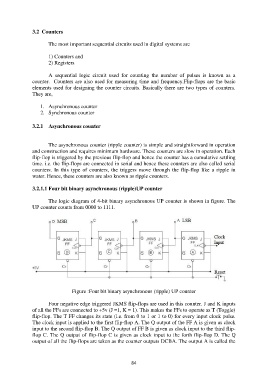
               3.2.1.1 Four bit binary asynchronous (ripple)UP counter

                       The logic diagram of 4-bit binary asynchronous UP counter is shown in figure. The
               UP counter counts from 0000 to 1111.


                                 Figure :Four bit binary asynchronous (ripple) UP counter

                       Four negative edge triggered JKMS flip-flops are used in this counter. J and K inputs
               of all the FFs are connected to +5v (J =1, K = 1). This makes the FFs to operate as T (Toggle)
               flip-flop. The T FF changes its state (i.e. from 0 to 1 or 1 to 0) for every input clock pulse.
               The clock input is applied to the first flip-flop A. The Q output of the FF A is given as clock
               input to the second flip-flop B. The Q output of FF B is given as clock input to the third flip-
               flop C. The Q output of flip-flop C is given as clock input to the forth flip-flop D. The Q
               output of all the flip-flops are taken as the counter outputs DCBA. The output A is called the


                                                           84

