


Page 20 - GeoPRISMS_Newsletter_Spring2018_Neat
P. 20
Hikurangi Ocean Bottom Investigation of


        Tremor and Slow Slip (HOBITSS) -


        Revealing the environment of shallow slow slip


        Susan Schwartz (UC Santa Cruz), Anne Sheehan (University Colorado, Boulder),
        Rachel Abercrombie (Boston University)


                                     n the last fifteen years, it has become evident that slow slip events (SSEs) are a common and important
                                     part of the subduction process. They produce millimeters to centimeters of surface displacement over
                                  Idays to years that can be measured by geodesy and are often accompanied by seismic tremor and
                                  earthquake swarms. Slow slip and tremor have been observed in subduction zones in Cascadia, Japan,
                                  Mexico, Alaska, Ecuador, northern Peru, Costa Rica and New Zealand.
                                  The 2014-15 HOBITSS deployment of 24 ocean bottom pressure sensors and fifteen ocean bottom
                                  seismometers (OBSs) at the northern Hikurangi margin, New Zealand captured a M7.0 SSE. The
                                  vertical deformation data collected were used to image one of the best-resolved slow slip distributions
                                  to date, and indicated slip very close, if not all the way to the trench (Wallace et al., 2016). The Fall 2016
                                  GeoPRISMS Newsletter reported on this experiment and how for the first time, ocean bottom pressure
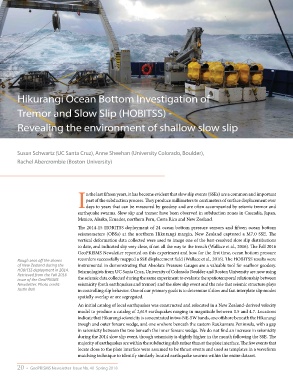
        Rough seas off the shores   recorders successfully mapped a SSE displacement field (Wallace et al., 2016). The HOBITSS results were
        of New Zealand during the   instrumental in demonstrating that Absolute Pressure Gauges are a valuable tool for seafloor geodesy.
        HOBITSS deployment in 2014.   Seismologists from UC Santa Cruz, University of Colorado Boulder and Boston University are now using
        Retrieved from the Fall 2016
        issue of the GeoPRISMS    the seismic data collected during the same experiment to evaluate the spatiotemporal relationship between
        Newsletter. Photo credit:   seismicity (both earthquakes and tremor) and the slow slip event and the role that seismic structure plays
        Justin Ball               in controlling slip behavior. One of our primary goals is to determine if slow and fast interplate slip modes
                                  spatially overlap or are segregated.

                                  An initial catalog of local earthquakes was constructed and relocated in a New Zealand-derived velocity
                                  model to produce a catalog of 2,619 earthquakes ranging in magnitude between 0.5 and 4.7. Locations
                                  indicate that Hikurangi seismicity is concentrated in two NE-SW bands, one offshore beneath the Hikurangi
                                  trough and outer forearc wedge, and one onshore beneath the eastern Raukumara Peninsula, with a gap
                                  in seismicity between the two beneath the inner forearc wedge. We do not find an increase in seismicity
                                  during the 2014 slow slip event, though seismicity is slightly higher in the month following the SSE. The
                                  majority of earthquakes are within the subducting slab rather than at the plate interface. The few events that
                                  locate close to the plate interface were assumed to be thrust events and used as templates in a waveform
                                  matching technique to identify similarly located earthquake swarms within the entire dataset.

        20  •  GeoPRISMS Newsletter  Issue No. 40  Spring 2018

