


Page 17 - GeoPRISMS_Newsletter_Spring2018_Neat
P. 17
the complete succession of incoming sedimentary and volcanic  Building on that background, JOIDES Resolution drilled along the
        strata on the subducting Hikurangi Plateau (a Cretaceous large  north Hikurangi transect to address three main goals:
        igneous province) including the overlying trench-wedge in the   1.   Documentation of the state and composition of the incoming
        Hikurangi Trough (Sites U1520 and U1526) (Fig. 2). Detailed thrust-  plate (sedimentary and volcanic rocks), as well as the shallow plate-
        sequence analysis via core-log-seismic integration will continue   boundary fault near the trench; these rocks comprise the protolith
        post-expedition. In addition to the coring program, borehole   and capture initial conditions for fault-zone rocks at greater depth,
        observatories were installed at Sites U1518 and U1519 to monitor   which can then be extrapolated to zones that host SSEs;
        in situ changes of fluid pressure, temperature, fluid-flow rate, and
        fluid geochemistry in the near-field of the SSEs.      2.   Quantification of material properties, thermal regime, and
                                                               stress conditions in the upper plate above the SSE source region; and
        Leg 181 of the Ocean Drilling Program had cored the eastern edge
        of the Hikurangi Plateau in 1998, largely for paleoceanographic   3.   Direct measurements of temporal variations in deformation,
        studies (Davy et al., 2008), but those sites are positioned ~600–900   temperature, and fluid flow using borehole observatories in the
        km seaward of the North Island. Many uncertainties remain with   near-field of the SSEs.
        respect to correlative stratigraphic successions currently entering  Results from a recent seafloor geodetic experiment near the IODP
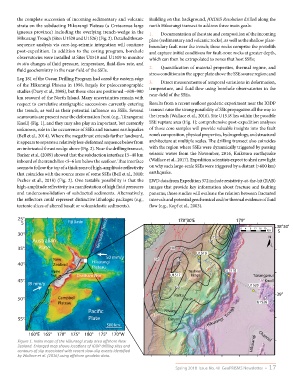
        the trench, as well as their potential influence on SSEs. Several  transect raise the strong possibility of SSE propagation all the way to
        seamounts are present near the deformation front (e.g., Tūranganui   the trench (Wallace et al., 2016). Site U1518 lies within the possible
        Knoll) (Fig. 1), and they may also play an important, but currently   SSE rupture area (Fig. 1); comprehensive post-expedition analyses
        unknown, role in the occurrence of SSEs and tsunami earthquakes   of those core samples will provide valuable insights into the fault
        (Bell et al., 2014). Where the megathrust extends farther landward,   zone’s composition, physical properties, hydrogeology, and structural
        it appears to separate a relatively less-deformed sequence below from   architecture at multiple scales. The drilling transect also coincides
        an imbricated thrust wedge above (Fig. 2). Near the drilling transect,   with the region where SSEs were dynamically triggered by passing
        Barker et al. (2009) showed that the subduction interface 15–40 km   seismic waves from the November, 2016, Kaikōura earthquake
        inboard of the trench lies <5–6 km below the seafloor. That interface   (Wallace et al., 2017). Expedition scientists expect to shed new light
        seems to follow the top of a thick zone of high-amplitude reflectivity   on why such large-scale SSEs were triggered by a distant (>600 km)
        that coincides with the source areas of some SSEs (Bell et al., 2010;   earthquake.
        Pecher et al., 2018) (Fig. 2). One testable possibility is that the  LWD data from Expedition 372 include resistivity-at-the-bit (RAB)
        high-amplitude reflectivity is a manifestation of high fluid pressures  images that provide key information about fracture and faulting
        and underconsolidation of subducted sediments. Alternatively,  patterns; those studies will evaluate the relation between fractured
        the reflectors could represent distinctive lithologic packages (e.g.,  intervals and potential geochemical and/or thermal evidence of fluid
        tectonic slices of altered basalt or volcaniclastic sediments).  flow (e.g., Kopf et al., 2003).

        25°                                                                178°30'E                 179°
           S                 Fiji Basin                                                                              38°30'

        30°                               Kermadec Trench                                 150        0  4  8  12 16 20  km  S
                                                                                                                 N
               Australian                                                               100
        35°      Plate                                                  100
                                                                                   U1519
                                             50 mm/y
                       New                                        50       200
        40°            Zealand          Hikurangi
                                        Plateau
                      Alpine                                                    Tuaheni        U1518
                      fault      Chatham Rise                           U1517    Ridge                     Tūranganui
        45°                                                                                                     Knoll
             39 mm/y
                                                                          150                            U1520
                                                                          Paritu                                     39°
        50°              Campbell                                             Basin
                         Plateau                                                                            U1526
                                      Pacic                          Poverty                   Trough
        55°                           Plate                            Canyon
                                              500 km                                    Hikurangi
             160°E 165°  170°  175°  180°  175° 170°W                                                        Channel
        Figure 1. Index maps of the Hikurangi study area offshore New
        Zealand. Enlarged map shows locations of IODP drilling sites and                                  Hikurangi
        contours of slip associated with recent slow-slip events identified
        by Wallace et al. (2016) using offshore geodetic data.

                                                                          Spring 2018  Issue No. 40  GeoPRISMS Newsletter  •  17

