


Page 18 - GeoPRISMS_Newsletter_Spring2018_Neat
P. 18
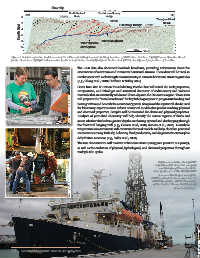
Slow slip

                 NW                        North Tuaheni     Frontal accretionary                        SE
              0                      U1519    Basin              wedge                          Tūranganui Knoll
              2                                                     U1518  Hikurangi Trough  U1520  U1526
             Depth (km)  4 6


              8                                                interplate thrust
                                                  1947 tsunami
             10                                   earthquake
                                                                                  10 km  VE = 2
        Figure 3. Seismic reflection profile crossing the HIkurangi drilling transect showing locations of IODP sites. Red lines highlight recently active thrust
        faults. Black lines highlight older, inactive faults. Interpretation is simplified from Pecher et al. (2018). See Figure 1 for position of trackline.

                                                The RAB data also document borehole breakouts, providing information about the
                                                orientations of maximum and minimum horizontal stresses. Those data will be used, in
                                                combination with rock strength measurements, to estimate horizontal stress magnitudes
                                                (e.g., Chang et al., 2010; Huffman & Saffer, 2016).
                                                Cores from Site U1520 on the subducting Pacific Plate will reveal the rock properties,
                                                composition, and lithologic and structural character of sedimentary and volcanic
                                                materials that are eventually subducted down-dip into the SSE source region. Those tests
                                           Photo by Tim Fulton, IODP-TAMU  heating within and beneath the accretionary prism. Samples of the inputs will also be used
                                                will pinpoint the “initial conditions” for key lithologies prior to progressive loading and
                                                for laboratory experiments to inform numerical models that predict evolving physical
                                                and chemical properties. Samples will be measured for elastic and physical properties.
                                                Analyses of pore-fluid chemistry will help identify the source regions of fluids and
                                                assess whether fluids from greater depths are flowing upward and discharging through
                                                the fractured hanging wall (e.g., Hensen et al., 2004; Ranero et al., 2008). Downhole
                                                temperature measurements will constrain thermal models and help elucidate potential
                                                connections among fault slip behavior, fluid production, and diagenetic/metamorphic
                                                dehydration reactions (e.g., Saffer et al., 2008).
                                                The two observatories will monitor volumetric strain (using pore pressure as a proxy),
                                                as well as the evolution of physical, hydrological, and chemical properties throughout
                                                multiple SSE cycles.


                                                                                                 Shipboard activities during IODP
                                                                                                Expedition 375. Scientists carefully
                                                                                                  examining a split core from the
                                                                                               main fault zone at Site U1518; IODP
                                                                                                 personnel working on one of the
                                                                                              CORK heads at the moon-pool level of
                                                                                              JOIDES Resolution. JOIDES Resolution
                                           Photo by D. Saffer                                              prior to departure.
                                                                                               at the dock in Timura, New Zealand,


                                                                                                                           Photo by Tim Fulton, IODP-TAMU


        18  •  GeoPRISMS Newsletter  Issue No. 40  Spring 2018

