


Page 16 - GeoPRISMS_Newsletter_Spring2018_Neat
P. 16
IODP tackles the Hikurangi Margin of

        New Zealand with two drilling expeditions


        to unlock the secrets of slow-slip events


        Michael Underwood (New Mexico Institute of Mining and Technology),

        Phil Barnes (National Institute of Water and Atmospheric Research), and
        Laura Wallace (UT Austin & GNS Science)


                                         ocumentation of slow-slip events (SSEs) and associated seismic phenomena (tremor, low frequency
                                         earthquakes, etc.), largely through recent deployments of dense geodetic and seismic networks,
                                  Dhas changed the paradigm of fault-slip behavior on subduction megathrusts (Schwartz and
                                  Rokosky, 2007; Peng and Gomberg, 2010; Wech and Creager, 2011; Saffer and Wallace, 2015). SSEs at the
                                  northern Hikurangi subduction margin, offshore the North Island of New Zealand (Fig. 1), are among the
                                  best-documented and shallowest examples on Earth. In that region, the Pacific plate subducts westward
                                  beneath the Australian plate at a rate of 4.5–5.5 cm/y (Wallace et al., 2004). SSEs recur there every 1–2 years
                                  over periods of 2–3 weeks at depths of <2–15 km below the seafloor (Wallace and Beavan, 2010; Wallace
                                  et al., 2016). The close proximity of Hikurangi SSEs to the seafloor makes them amenable to study using
                                  the U.S. drilling vessel JOIDES Resolution. This is also an ideal locale for using sub-seafloor observatories
                                  to monitor near-field deformation and associated changes in chemical and physical properties throughout
                                  multiple slow-slip cycles.

                                  The International Ocean Discovery Program (IODP) directed its attention and resources toward the
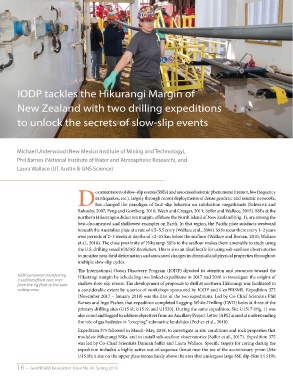
        IODP personnel transferring   Hikurangi margin by scheduling two linked expeditions in 2017 and 2018 to investigate the origins of
        a sedimentfilled core liner
        from the rig floor to the core-  shallow slow-slip events. The development of proposals to drill at northern Hikurangi was facilitated to
        cutting area.             a considerable extent by a series of workshops sponsored by IODP and GeoPRISMS. Expedition 372
                                  (November 2017 – January 2018) was the first of the two expeditions. Led by Co-Chief Scientists Phil
                                  Barnes and Ingo Pecher, that expedition completed Logging-While-Drilling (LWD) holes at three of the
                                  primary drilling sites (U1518, U1519, and U1520). During the same expedition, Site U1517 (Fig. 1) was
                                  also cored and logged to address objectives from an Ancillary Project Letter (APL) aimed at understanding
                                  the role of gas hydrates in “creeping” submarine landslides (Pecher et al., 2018).
                                  Expedition 375 followed in March–May, 2018, to investigate in situ conditions and rock properties that
                                  modulate Hikurangi SSEs, and to install sub-seafloor observatories (Saffer et al., 2017). Expedition 375
                                  was led by Co-Chief Scientists Demian Saffer and Laura Wallace. Specific targets for coring during the
                                  expedition included a highly active out-of-sequence thrust near the toe of the accretionary prism (Site
                                  U1518); a site on the upper plate immediately above the area that undergoes large SSE slip (Site U1519);

        16  •  GeoPRISMS Newsletter  Issue No. 40  Spring 2018

