


Page 15 - GeoPRISMS_Newsletter_Spring2018_Neat
P. 15
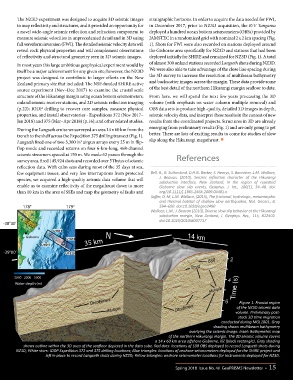
The NZ3D experiment was designed to acquire 3D seismic images  stratigraphic horizons. In order to acquire the data needed for FWI,
        to map reflectivity and structures, and it provided an opportunity for  in December 2017, prior to NZ3D acquisition, the R/V Tangaroa
        a novel wide-angle seismic reflection and refraction component to  deployed a hundred ocean bottom seismometers (OBSs) provided by
        measure seismic velocities in unprecedented detail and in 3D using  JAMSTEC in a randomized grid with nominal 2 x 2 km spacing (Fig.
        full waveform inversion (FWI). The detailed seismic velocity data will  1). Shots for FWI were also recorded on stations deployed around
        reveal rock physical properties and will complement observations  the Gisborne area specifically for NZ3D and stations that had been
        of reflectivity and structural geometry seen in 3D seismic images.  deployed initially for SHIRE and remained for NZ3D (Fig. 1). A total
        In most years this large ambitious geophysical experiment would by   of almost 300 onland stations recorded Langseth shots during NZ3D.
        itself be a major achievement for any given site; however, the NZ3D   We were also able to take advantage of the close line spacing during
        project was designed to contribute to larger efforts on the New   the 3D survey to increase the resolution of multibeam bathymetry
        Zealand primary site that included: The NSF-funded SHIRE active   and backscatter images across the margin. These data provide some
        source experiment (Nov–Dec 2017) to examine the crustal scale   of the best detail of the northern Hikurangi margin seafloor to date.
        structure of the Hikurangi margin using ocean bottom seismometers,  From here, we will spend the next few years processing the 3D
        onland seismic receiver stations, and 2D seismic reflection imaging  volume (with emphasis on water column multiple removal) and
        (p.22); IODP drilling to recover core samples, measure physical  OBS data sets to produce high-quality, detailed 3D images in depth,
        properties, and install observatories - Expeditions 372 (Nov 2017–  seismic velocity data, and interpret these results in the context of new
        Jan 2018) and 375 (Mar–Apr 2018) (p.16); and other related studies.  results from the coordinated projects. Structures in 3D are already
        During the Langseth cruise we surveyed an area 14 x 60 km from the   emerging from preliminary results (Fig. 1) and are only going to get
        trench to the shelf across the Expedition 375 drilling transect (Fig. 1).   better. There are lots of exciting results to come for studies of slow
                                                               slip along the Hikurangi megathrust. ■
        Langseth fired one of two 3,300 in  airgun arrays every 25 m in flip-
                                   3
        flop mode and recorded returns on four 6-km-long, 468-channel
        seismic streamers spaced at 150 m. We made 62 passes through the   References
        survey area, fired 145,924 shots and recorded over 5Tbytes of seismic
        reflection data. With calm seas during most of the 35 days at sea,
        few equipment issues, and very few interruptions from protected   Bell, R., R. Sutherland, D.H.N. Barker, S. Henrys, S. Bannister, L.M. Wallace,
        species, we acquired a high-quality seismic data volume that will   J.  Beavan,  (2010),  Seismic  reflection  character  of  the  Hikurangi
                                                                    subduction  interface,  New  Zealand,  in  the  region  of  repeated
        enable us to examine reflectivity of the megathrust down to more   Gisborne  slow  slip  events,  Geophys.  J.  Int.,  180(1),  34–48.  doi.
        than 10 km in the area of SSEs and map the geometry of faults and   org/10.1111/j.1365-246X.2009.04401.x
                                                                Saffer, D. M, L.M. Wallace, (2015), The frictional, hydrologic, metamorphic
                                                                    and thermal habitat of shallow slow earthquakes, Nat. Geosci., 8,
           178°              179°                                   594–600. doi:10.1038/ngeo2490
                                                                Wallace, L.M., J. Beavan (2010), Diverse slow slip behavior at the Hikurangi
                                                                    subduction  margin,  New  Zealand,  J.  Geophys.  Res.,  115,  B12402.
                                                                    doi:10.1029/2010JB007717
  -38°30’


                                    35 km

  -39°00’


       3000 2000 1000
       Water depth (m)


                                                                                                     Figure 1. Frontal region
                                                                                                    of the NZ3D seismic data
                                                                                                   volume. Preliminary post‐
                                                                                                     stack 3D time migration
                                                                                             conducted during MGL1801. Gray
                                                                                          shading shows multibeam bathymetry
                                                                                overlying the seismic image. Inset: Bathymetric map
                                                                       of the northern Hikurangi margin. The 3D seismic volume covers
                                                                  a 14 x 60 km area offshore Gisborne, NZ (black rectangle). Gray shading
           shows outline within the 3D area of the seafloor depicted in the data cube. Red dots: locations of 100 OBS deployed to record Langseth shots during
        NZ3D; White stars: IODP Expedition 372 and 375 drilling locations; Blue triangles: locations of onshore seismometers deployed for the SHIRE project and
                    left in place to record Langseth shots during NZ3D; Yellow triangles: onshore seismometer locations for instruments deployed for NZ3D.

                                                                          Spring 2018  Issue No. 40  GeoPRISMS Newsletter  •  15

