


Page 161 - text book form physics kssm 2020
P. 161
Chapter 4
                                                                                                     Heat
                                                                                       3
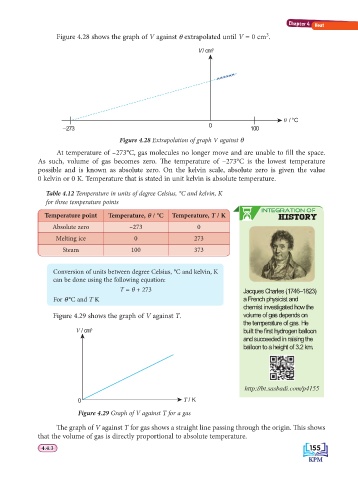
                        Figure 4.28 shows the graph of V against θ extrapolated until V = 0 cm .
                                                                  V / cm 3


                                                                                            e / °C
                                                                      0
                          –273                                                    100
                                           Figure 4.28 Extrapolation of graph V against θ

                        At temperature of –273°C, gas molecules no longer move and are unable to fi ll the space.
                  As such, volume of gas becomes zero. Th  e temperature of –273°C is the lowest temperature
                  possible and is known as absolute zero. On the kelvin scale, absolute zero is given the value
                  0 kelvin or 0 K. Temperature that is stated in unit kelvin is absolute temperature.

                     Table 4.12 Temperature in units of degree Celsius, °C and kelvin, K
                     for three temperature points
                                                                                     INTEGRATION OF
                    Temperature point  Temperature, θ / °C  Temperature, T / K             HISTORY

                       Absolute zero          –273                0
                        Melting ice            0                 273
                          Steam               100                373


                       Conversion of units between degree Celsius, °C and kelvin, K
                       can be done using the following equation:
                                           T = θ + 273                          Jacques Charles (1746–1823)
                       For θ °C and T K                                         a French physicist and
                                                                                chemist investigated how the
                       Figure 4.29 shows the graph of V against T.              volume of gas depends on
                                                                                the temperature of gas. He
                              V / cm 3                                          built the fi rst hydrogen balloon
                                                                                and succeeded in raising the
                                                                                balloon to a height of 3.2 km.


                                                                                http://bt.sasbadi.com/p4155
                              0                               T / K
                              Figure 4.29 Graph of V against T for a gas

                        Th  e graph of V against T for gas shows a straight line passing through the origin. Th is shows
                  that the volume of gas is directly proportional to absolute temperature.
                                                                                                    155
                   4.4.3                                                                            155
                   4.4.3

