


Page 95 - Encyclopedia of Aquarium and Pond Fish, 3rd Edition
P. 95
CHARACOIDS/PREDATORY SPECIES    93


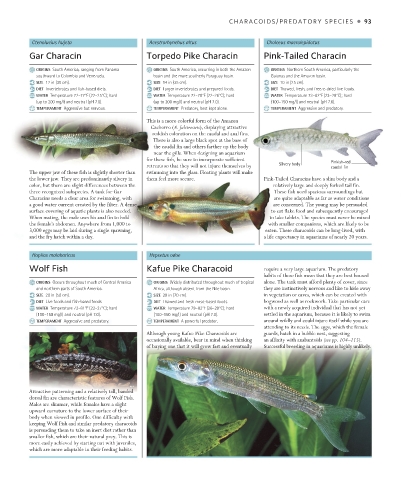
          Ctenolucius hujeta              Acestrorhynchus altus           Chalceus macrolepidotus
         Gar Characin                    Torpedo Pike Characin            Pink-Tailed Characin

           ORIGINS  South America, ranging from Panama   ORIGINS  South America, occurring in both the Amazon   ORIGINS  Northern South America, particularly the
           southward to Colombia and Venezuela.   basin and the more southerly Paraguay basin.   Guianas and the Amazon basin.
           SIZE  12 in (30 cm).            SIZE  14 in (35 cm).             SIZE  10 in (25 cm).
           DIET  Invertebrates and fish-based diets.  DIET  Larger invertebrates and prepared foods.  DIET  Thawed, fresh, and freeze-dried live foods.
           WATER  Temperature 72–77°F (22–25°C); hard    WATER  Temperature 72–79°F (22–26°C); hard   WATER  Temperature 73–82°F (23–28°C); hard
           (up to 200 mg/l) and neutral (pH 7.0).  (up to 200 mg/l) and neutral (pH 7.0).  (100–150 mg/l) and neutral (pH 7.0).
           TEMPERAMENT  Aggressive but nervous.  TEMPERAMENT  Predatory, best kept alone.  TEMPERAMENT  Aggressive and predatory.
                                         This is a more colorful form of the Amazon
                                           Cachorro (A. falcirostris), displaying attractive
                                           reddish coloration on the caudal and anal fins.
                                           There is also a large black spot at the base of
                                           the caudal fin and others farther up the body
                                           near the gills. When designing an aquarium
                                         for these fish, be sure to incorporate sufficient   Pinkish-red
                                         retreats so that they will not injure themselves by   Silvery body  caudal fin
         The upper jaw of these fish is slightly shorter than   swimming into the glass. Floating plants will make
         the lower jaw. They are predominantly silvery in   them feel more secure.  Pink-Tailed Characins have a slim body and a
         color, but there are slight differences between the                relatively large and deeply forked tail fin.
         three recognized subspecies. A tank for Gar                         These fish need spacious surroundings but
         Characins needs a clear area for swimming, with                     are quite adaptable as far as water conditions
         a good water current created by the filter. A dense                are concerned. The young may be persuaded
         surface covering of aquatic plants is also needed.                 to eat flake food and subsequently encouraged
         When mating, the male uses his anal fin to hold                   to take tablets. The species must never be mixed
         the female’s abdomen. Anywhere from 1,000 to                      with smaller companions, which are likely to be
         3,000 eggs may be laid during a single spawning,                 eaten. These characoids can be long-lived, with
         and the fry hatch within a day.                                  a life expectancy in aquariums of nearly 20 years.

          Hoplias malabaricus             Hepsetus odoe
         Wolf Fish                       Kafue Pike Characoid             require a very large aquarium. The predatory
                                                                          habits of these fish mean that they are best housed
           ORIGINS  Occurs throughout much of Central America   ORIGINS  Widely distributed throughout much of tropical   alone. The tank must afford plenty of cover, since
           and northern parts of South America.  Africa, although absent from the Nile basin.  they are instinctively nervous and like to hide away
           SIZE  20 in (50 cm).            SIZE  28 in (70 cm).           in vegetation or caves, which can be created with
           DIET  Live foods and fish-based foods.  DIET  Thawed and fresh meat-based foods.  bogwood as well as rockwork. Take particular care
           WATER  Temperature 72–81°F (22–27°C); hard    WATER  Temperature 79–82°F (26–28°C); hard    with a newly acquired individual that has not yet
           (100–150 mg/l) and neutral (pH 7.0).  (100–150 mg/l) and neutral (pH 7.0).  settled in the aquarium, because it is likely to swim
           TEMPERAMENT  Aggressive and predatory.  TEMPERAMENT  A powerful predator.  around wildly and could injure itself while you are
                                                                          attending to its needs. The eggs, which the female
                                         Although young Kafue Pike Characoids are   guards, hatch in a bubble nest, suggesting
                                         occasionally available, bear in mind when thinking   an affinity with anabantoids (see pp. 104–115).
                                         of buying one that it will grow fast and eventually   Successful breeding in aquariums is highly unlikely.


         Attractive patterning and a relatively tall, banded
         dorsal fin are characteristic features of Wolf Fish.
         Males are slimmer, while females have a slight
         upward curvature to the lower surface of their
         body when viewed in profile. One difficulty with
         keeping Wolf Fish and similar predatory characoids
         is persuading them to take an inert diet rather than
         smaller fish, which are their natural prey. This is
         more easily achieved by starting out with juveniles,
         which are more adaptable in their feeding habits.


   US_092-093_Predatory_Species.indd   93                                                            29/08/18   4:09 PM

