


Page 117 - Encyclopedia of Aquarium and Pond Fish, 3rd Edition
P. 117
ANABANTOIDS/BUSHFISH    115


          Microctenopoma ansorgii         Nandus nandus                   Polycentrus schomburgkii
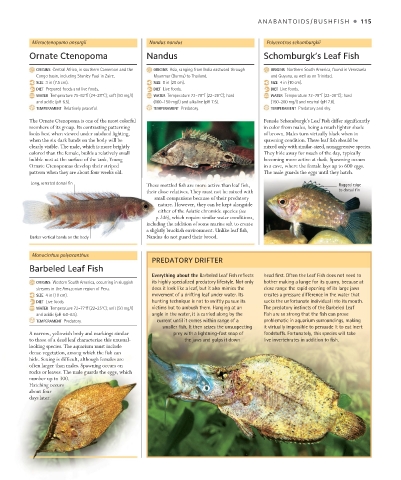
         Ornate Ctenopoma                Nandus                           Schomburgk’s Leaf Fish

           ORIGINS  Central Africa, in southern Cameroon and the   ORIGINS  Asia, ranging from India eastward through   ORIGINS  Northern South America, found in Venezuela
           Congo basin, including Stanley Pool in Zaire.  Myanmar (Burma) to Thailand.  and Guyana, as well as on Trinidad.
           SIZE  3 in (7.5 cm).            SIZE  8 in (20 cm).              SIZE  4 in (10 cm).
           DIET  Prepared foods and live foods.  DIET  Live foods.          DIET  Live foods.
           WATER  Temperature 75–82°F (24–28°C); soft (50 mg/l)   WATER  Temperature 72–79°F (22–26°C); hard   WATER  Temperature 72–79°F (22–26°C); hard
           and acidic (pH 6.5).            (100–150 mg/l) and alkaline (pH 7.5).   (150–200 mg/l) and neutral (pH 7.0).
           TEMPERAMENT  Relatively peaceful.  TEMPERAMENT  Predatory.       TEMPERAMENT  Predatory and shy.
         The Ornate Ctenopoma is one of the most colorful                 Female Schomburgk’s Leaf Fish differ significantly
         members of its group. Its contrasting patterning                 in color from males, being a much lighter shade
         looks best when viewed under subdued lighting,                   of brown. Males turn virtually black when in
         when the six dark bands on the body will be                      spawning condition. These leaf fish should be
         clearly visible. The male, which is more brightly                mixed only with similar-sized, nonaggressive species.
         colored than the female, builds a relatively small               They hide away for much of the day, typically
         bubble nest at the surface of the tank. Young                    becoming more active at dusk. Spawning occurs
         Ornate Ctenopomas develop their striped                          in a cave, where the female lays up to 600 eggs.
         pattern when they are about four weeks old.                      The male guards the eggs until they hatch.
         Long, serrated dorsal fin       These mottled fish are more active than leaf fish,   Ragged edge
                                         their close relatives. They must not be mixed with   to dorsal fin
                                            small companions because of their predatory
                                             nature. However, they can be kept alongside
                                             either of the Asiatic chromide species (see
                                            p.146), which require similar water conditions,
                                         including the addition of some marine salt to create
                                         a slightly brackish environment. Unlike leaf fish,
         Darker vertical bands on the body  Nandus do not guard their brood.

          Monocirrhus polyacanthus
                                           PREDATORY DRIFTER
         Barbeled Leaf Fish
                                           Everything about the Barbeled Leaf Fish reflects   head first. Often the Leaf Fish does not need to
           ORIGINS  Western South America, occurring in sluggish   its highly specialized predatory lifestyle. Not only   bother making a lunge for its quarry, because at
           streams in the Amazonian region of Peru.   does it look like a leaf, but it also mimics the   close range the rapid opening of its large jaws
           SIZE  4 in (10 cm).             movement of a drifting leaf under water. Its   creates a pressure difference in the water that
           DIET  Live foods.               hunting technique is not to swiftly pursue its   sucks the unfortunate individual into its mouth.
           WATER  Temperature 72–77°F (22–25°C); soft (50 mg/l)   victims but to ambush them. Hanging at an   The predatory instincts of the Barbeled Leaf
           and acidic (pH 6.0–6.5).        angle in the water, it is carried along by the   Fish are so strong that the fish can prove
           TEMPERAMENT  Predatory.          current until it comes within range of a   problematic in aquarium surroundings, making
                                              smaller fish. It then seizes the unsuspecting   it virtually impossible to persuade it to eat inert
         A narrow, yellowish body and markings similar    prey with a lightning-fast snap of    foodstuffs. Fortunately, this species will take
         to those of a dead leaf characterize this unusual-  the jaws and gulps it down    live invertebrates in addition to fish.
         looking species. The aquarium must include
         dense vegetation, among which the fish can
         hide. Sexing is difficult, although females are
         often larger than males. Spawning occurs on
         rocks or leaves. The male guards the eggs, which
         number up to 300.
         Hatching occurs
         about four
         days later.


   US_114-115_Gouramis_Cont.indd   115                                                               29/08/18   4:09 PM

