


Page 119 - Encyclopedia of Aquarium and Pond Fish, 3rd Edition
P. 119
CATFISH     117


                                          Bunocephalus coracoideus        Pareutropius debauwi
           PUTTING OUT FEELERS
                                         Banjo Catfish                    African Glass Catfish
           The different shapes and sizes of the
           sensory barbels surrounding the mouths of   ORIGINS  South America, occurring in the Amazon basin,   ORIGINS  West Africa, occurring in the Congo and also
           catfish provide an insight into their differing   extending to the vicinity of La Plata.  in Gabon.
           lifestyles. Often likened to feelers, barbels   SIZE  6 in (15 cm).  SIZE  3 in (7.5 cm).
           give catfish additional sensory information   DIET  Pellets, tablets, and sinking live food.  DIET  Small live foods, fresh or freeze-dried, plus flake.
           about their environment. Active predatory   WATER  Temperature 70–79°F (21–26°C); soft to hard   WATER  Temperature 72–79°F (22–26°C); soft to hard
           catfish hunt by sweeping long barbels from   (50–200 mg/l) and acidic to alkaline (pH 6.0–7.8).  (50–150 mg/l) and acidic to near neutral (pH 6.5–7.2).
           side to side as they swim, which helps them   TEMPERAMENT  Placid and sedentary.  TEMPERAMENT  Very placid and social.
           to detect and home in on potential prey. The
           longest barbels are seen in nocturnal species,                 These fish should be kept in small groups to
           or species that hunt in turbid waters where                    ensure the presence of at least one pair, because
           visibility is restricted. In contrast, more                    it is difficult to distinguish the sexes until females
           sedentary or vegetarian catfish have very                      swell with eggs. Ideally, two males should be
           much shorter barbels, which act as a sensory                   housed in the breeding tank with a single female.
           supplement to the eyes.                                        Typically, she will lay up to 100 white eggs in the
                                                                          morning, after which the fish should be returned
                                                                          to the main aquarium. The catfish fry will hatch
                                                                          within three days, and are easy to rear on brine
                                                                          shrimp. Adults will take insect larvae very readily,
                                         This catfish rarely strays far from the substrate    especially bloodworm.
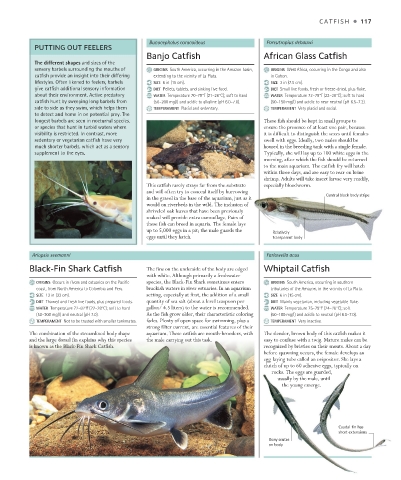
                                         and will often try to conceal itself by burrowing    Central black body stripe
                                         in the gravel in the base of the aquarium, just as it
                                         would on riverbeds in the wild. The inclusion of
                                         shriveled oak leaves that have been previously
                                         soaked will provide extra camouflage. Pairs of
                                         these fish can breed in aquaria. The female lays
                                         up to 5,000 eggs in a pit; the male guards the    Relatively
                                         eggs until they hatch.             transparent body

          Ariopsis seemanni                                               Farlowella acus
         Black-Fin Shark Catfish         The fins on the underside of the body are edged   Whiptail Catfish
                                         with white. Although primarily a freshwater
           ORIGINS  Occurs in rivers and estuaries on the Pacific   species, the Black-Fin Shark sometimes enters   ORIGINS  South America, occurring in southern
           coast, from North America to Colombia and Peru.   brackish waters in river estuaries. In an aquarium   tributaries of the Amazon, in the vicinity of La Plata.
           SIZE  13 in (33 cm).          setting, especially at first, the addition of a small   SIZE  6 in (15 cm).
           DIET  Thawed and fresh live foods, plus prepared foods.  quantity of sea salt (about a level teaspoon per   DIET  Mainly vegetarian, including vegetable flake.
           WATER  Temperature 72–82°F (22–28°C); soft to hard   gallon/ 4.5 liters) to the water is recommended.   WATER  Temperature 75–79°F (24–26°C); soft
           (50–300 mg/l) and neutral (pH 7.0).  As the fish grow older, their characteristic coloring   (50–100 mg/l) and acidic to neutral (pH 6.0–7.0).
           TEMPERAMENT  Not to be trusted with smaller tankmates.  fades. Plenty of open space for swimming, plus a   TEMPERAMENT  Very inactive.
                                         strong filter current, are essential features of their
         The combination of the streamlined body shape   aquarium. These catfish are mouth-brooders, with   The slender, brown body of this catfish makes it
         and the large dorsal fin explains why this species    the male carrying out this task.  easy to confuse with a twig. Mature males can be
         is known as the Black-Fin Shark Catfish.                         recognized by bristles on their snouts. About a day
                                                                          before spawning occurs, the female develops an
                                                                          egg-laying tube called an ovipositor. She lays a
                                                                          clutch of up to 60 adhesive eggs, typically on
                                                                            rocks. The eggs are guarded,
                                                                              usually by the male, until
                                                                               the young emerge.


                                                                                              Caudal fin has
                                                                                              short extensions
                                                                           Bony scutes
                                                                           on body


   US_116-117_catfish.indd   117                                                                     29/08/18   4:09 PM

