


Page 118 - Encyclopedia of Aquarium and Pond Fish, 3rd Edition
P. 118
116    FRESHWATER FISH DIRECTORY

         CATFISH


         Catfish represent one of the largest groups of aquarium
         fish and also one of the most diverse in terms of
         appearance and lifestyle. There are more than 2,000
         species in approximately 30 families. Some of these
         fish are sedentary and suitable for a community tank,
         while others are active predators that grow to a large
         size. Identification is not always easy, partly because
         members of the same species often show differences
         in patterning and partly because new species are
         constantly being discovered. The complex and
         expanding nature of one catfish family, the Loricariids,
         has led to the development of a classification system
         based on “L” numbers (see p. 21).
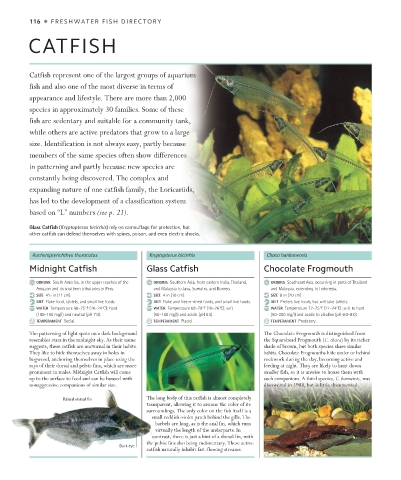
         Glass Catfish (Kryptopterus bicirrhis) rely on camouflage for protection, but
         other catfish can defend themselves with spines, poison, and even electric shocks.

          Auchenipterichthys thoracatus   Kryptopterus bicirrhis          Chaca bankanensis
         Midnight Catfish                Glass Catfish                    Chocolate Frogmouth

           ORIGINS  South America, in the upper reaches of the   ORIGINS  Southern Asia, from eastern India, Thailand,   ORIGINS  Southeast Asia, occurring in parts of Thailand
           Amazon and its southern tributaries in Peru.  and Malaysia to Java, Sumatra, and Borneo.   and Malaysia, extending to Indonesia.
           SIZE  4 ⁄2 in (11 cm).          SIZE  4 in (10 cm).              SIZE  8 in (20 cm).
              1
           DIET  Flake food, tablets, and small live foods.  DIET  Flake and freeze-dried foods, and small live foods.  DIET  Prefers live foods, but will take tablets.
           WATER  Temperature 68–75°F (20–24°C); hard    WATER  Temperature 68–79°F (20–26°C); soft    WATER  Temperature 72–75°F (22–24°C); soft to hard
           (100–150 mg/l) and neutral (pH 7.0).  (50–100 mg/l) and acidic (pH 6.5).  (50–200 mg/l) and acidic to alkaline (pH 6.0–8.0).
           TEMPERAMENT  Social.            TEMPERAMENT  Placid.             TEMPERAMENT  Predatory.
         The patterning of light spots on a dark background               The Chocolate Frogmouth is distinguished from
         resembles stars in the midnight sky. As their name               the Squarehead Frogmouth (C. chaca) by its richer
         suggests, these catfish are nocturnal in their habits.           shade of brown, but both species share similar
         They like to hide themselves away in holes in                    habits. Chocolate Frogmouths hide under or behind
         bogwood, anchoring themselves in place using the                 rockwork during the day, becoming active and
         rays of their dorsal and pelvic fins, which are more             feeding at night. They are likely to hunt down
         prominent in males. Midnight Catfish will come                   smaller fish, so it is unwise to house them with
         up to the surface to feed and can be housed with                 such companions. A third species, C. burmensis, was
         nonaggressive companions of similar size.                        discovered in 1988, but is little documented.
                  Raised dorsal fin      The long body of this catfish is almost completely
                                         transparent, allowing it to assume the color of its
                                         surroundings. The only color on the fish itself is a
                                           small reddish-violet patch behind the gills. The
                                            barbels are long, as is the anal fin, which runs
                                            virtually the length of the underparts. In
                                           contrast, there is just a hint of a dorsal fin, with
                                         the pelvic fins also being rudimentary. These active
                                  Dark eye
                                         catfish naturally inhabit fast-flowing streams.


   US_116-117_catfish.indd   116                                                                     29/08/18   4:09 PM

