


Page 120 - Encyclopedia of Aquarium and Pond Fish, 3rd Edition
P. 120
118    FRESHWATER FISH DIRECTORY


          Platydoras costatus                                             Hara hara
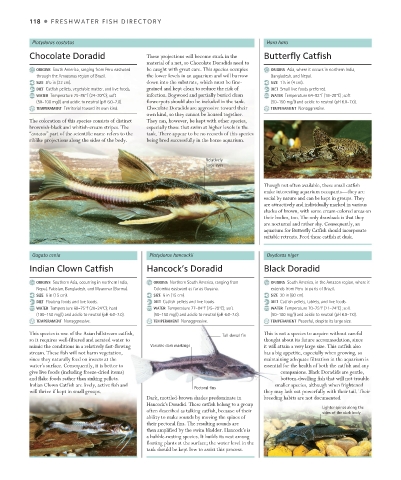
         Chocolate Doradid               These projections will become stuck in the   Butterfly Catfish
                                         material of a net, so Chocolate Doradids need to
           ORIGINS  South America, ranging from Peru eastward   be caught with great care. This species occupies   ORIGINS  Asia, where it occurs in northern India,
           through the Amazonas region of Brazil.  the lower levels in an aquarium and will burrow   Bangladesh, and Nepal.
              1
                                                                               1
           SIZE  8 ⁄2 in (22 cm).        down into the substrate, which must be fine-  SIZE  1 ⁄2 in (4 cm).
           DIET  Catfish pellets, vegetable matter, and live foods.  grained and kept clean to reduce the risk of   DIET  Small live foods preferred.
           WATER  Temperature 75–86°F (24–30°C); soft   infection. Bogwood and partially buried clean   WATER  Temperature 64–82°F (18–28°C); soft
           (50–100 mg/l) and acidic to neutral (pH 6.0–7.0).   flowerpots should also be included in the tank.   (50–150 mg/l) and acidic to neutral (pH 6.0–7.0).
           TEMPERAMENT  Territorial toward its own kind.  Chocolate Doradids are aggressive toward their   TEMPERAMENT  Nonaggressive.
                                         own kind, so they cannot be housed together.
         The coloration of this species consists of distinct   They can, however, be kept with other species,
         brownish-black and whitish-cream stripes. The   especially those that swim at higher levels in the
         “costatus” part of the scientific name refers to the   tank. There appear to be no records of this species
         riblike projections along the sides of the body.   being bred successfully in the home aquarium.
                                                          Relatively
                                                          large eyes

                                                                          Though not often available, these small catfish
                                                                          make interesting aquarium occupants—they are
                                                                          social by nature and can be kept in groups. They
                                                                          are attractively and individually marked in various
                                                                          shades of brown, with some cream-colored areas on
                                                                          their bodies, too. The only drawback is that they
                                                                          are nocturnal and rather shy. Consequently, an
                                                                          aquarium for Butterfly Catfish should incorporate
                                                                          suitable retreats. Feed these catfish at dusk.

          Gagata cenia                    Platydoras hancockii            Oxydoras niger
         Indian Clown Catfish            Hancock’s Doradid                Black Doradid

           ORIGINS  Southern Asia, occurring in northern India,   ORIGINS  Northern South America, ranging from   ORIGINS  South America, in the Amazon region, where it
           Nepal, Pakistan, Bangladesh, and Myanmar (Burma).  Colombia eastward as far as Guyana.  extends from Peru to parts of Brazil.
           SIZE  6 in (15 cm).             SIZE  6 in (15 cm).              SIZE  30 in (80 cm).
           DIET  Floating foods and live foods.  DIET  Catfish pellets and live foods.  DIET  Catfish pellets, tablets, and live foods.
           WATER  Temperature 68–75°F (20–24°C); hard   WATER  Temperature 77–84°F (25–29°C); soft   WATER  Temperature 70–75°F (21–24°C); soft
           (100–150 mg/l) and acidic to neutral (pH 6.0–7.0).  (50–150 mg/l) and acidic to neutral (pH 6.0 –7.0).  (50–100 mg/l) and acidic to neutral (pH 6.0–7.0).
           TEMPERAMENT  Nonaggressive.     TEMPERAMENT  Nonaggressive.      TEMPERAMENT  Peaceful, despite its large size.
         This species is one of the Asian hillstream catfish,   Tall dorsal fin  This is not a species to acquire without careful
         so it requires well-filtered and aerated water to                thought about its future accommodation, since
         mimic the conditions in a relatively fast-flowing   Variable dark markings  it will attain a very large size. This catfish also
         stream. These fish will not harm vegetation,                     has a big appetite, especially when growing, so
         since they naturally feed on insects at the                      maintaining adequate filtration in the aquarium is
         water’s surface. Consequently, it is better to                   essential for the health of both the catfish and any
         give live foods (including freeze-dried items)                       companions. Black Doradids are gentle,
         and flake foods rather than sinking pellets.                         bottom-dwelling fish that will not trouble
         Indian Clown Catfish are lively, active fish and   Pectoral fins    smaller species, although when frightened
         will thrive if kept in small groups.                             they may lash out powerfully with their tail. Their
                                         Dark, mottled-brown shades predominate in   breeding habits are not documented.
                                         Hancock’s Doradid. These catfish belong to a group
                                         often described as talking catfish, because of their   Lighter spines along the
                                                                                          sides of the dark body
                                         ability to make sounds by moving the spines of
                                         their pectoral fins. The resulting sounds are
                                         then amplified by the swim bladder. Hancock’s is
                                         a bubble-nesting species. It builds its nest among
                                         floating plants at the surface; the water level in the
                                         tank should be kept low to assist this process.


   US_118-119_Catfish_2.indd   118                                                                   29/08/18   4:09 PM

