


Page 122 - Encyclopedia of Aquarium and Pond Fish, 3rd Edition
P. 122
120    FRESHWATER FISH DIRECTORY


          Dianema longibarbus             Callichthys callichthys         Megalechis thoracata
         Porthole Catfish                Slender Armored Catfish          Thorocatum Catfish

           ORIGINS  Northwestern South America, in the Ambylac   ORIGINS  South America, from Peru eastward to    ORIGINS  Northern South America, reaching as far south
           and Pacaya Rivers in Peru.      Guyana, eastern Brazil, Paraguay, and Bolivia.   as Paraguay; also offshore islands, including Trinidad.
           SIZE  4 in (10 cm).             SIZE  8 in (20 cm).              SIZE  8 in (20 cm).
           DIET  Prepared foods and live foods.   DIET  Prepared foods and live foods.   DIET  Prepared foods and live foods.
           WATER  Temperature 72–79°F (22–26°C); soft    WATER  Temperature 64–82°F (18–28°C); soft    WATER  Temperature 64–82°F (18–28°C); soft
           (50–100 mg/l) and acidic (pH 6.5).   (50–100 mg/l) and acidic (pH 6.5).  (50–100 mg/l) and acidic (pH 6.5).
           TEMPERAMENT  Social and nonaggressive.  TEMPERAMENT  Social and nonaggressive.  TEMPERAMENT  Relatively peaceful.
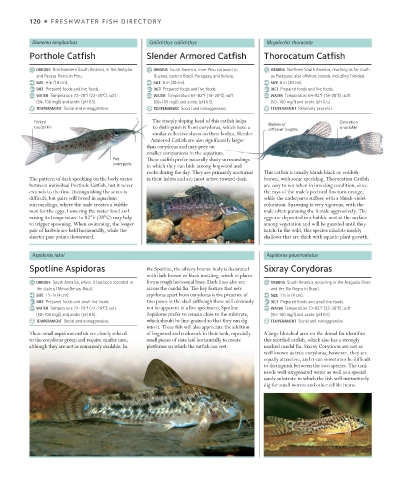
          Forked                           The steeply sloping head of this catfish helps    Barbels of   Coloration
          caudal fin                       to distinguish it from corydoras, which have a   different lengths  is variable
                                           similar reflective sheen on their bodies. Slender
                                           Armored Catfish are also significantly larger
                                         than corydoras and may prey on
                                         smaller companions in the aquarium.
                                Pale     These catfish prefer naturally shady surroundings
                                underparts  in which they can hide among bogwood and
                                         rocks during the day. They are primarily nocturnal   This catfish is usually bluish-black or reddish-
         The pattern of dark speckling on the body varies   in their habits and are most active toward dusk.  brown, with some speckling. Thorocatum Catfish
         between individual Porthole Catfish, but it never                are easy to sex when in breeding condition, since
         extends to the fins. Distinguishing the sexes is                 the rays of the male’s pectoral fins turn orange,
         difficult, but pairs will breed in aquarium                      while the underparts suffuse with a bluish-violet
         surroundings, where the male creates a bubble                    coloration. Spawning is very vigorous, with the
         nest for the eggs. Lowering the water level and                  male often pursuing the female aggressively. The
         raising its temperature to 82°F (28°C) may help                  eggs are deposited in a bubble nest at the surface
         to trigger spawning. When swimming, the longer                   among vegetation and will be guarded until they
         pair of barbels are held horizontally, while the                 hatch. In the wild, this species inhabits muddy
         shorter pair points downward.                                    shallows that are thick with aquatic plant growth.

          Aspidoras lakoi                                                 Aspidoras pauciradiatus
         Spotline Aspidoras              the Spotline, the silvery-bronze body is decorated   Sixray Corydoras
                                         with dark brown or black mottling, which in places
           ORIGINS  South America, where it has been recorded in   forms rough horizontal lines. Dark lines also arc   ORIGINS  South America, occurring in the Araguaia River,
           the state of Minas Gerais, Brazil.  across the caudal fin. The key feature that sets   and the Rio Negro in Brazil.
           SIZE  1 ⁄2 in (4 cm).         aspidoras apart from corydoras is the presence of   SIZE  1 ⁄2 in (4 cm).
              1
                                                                               1
           DIET  Prepared foods and small live foods.  two pores in the skull (although these will obviously   DIET  Prepared foods and small live foods.
           WATER  Temperature 72 –79°F (22–26°C); soft    not be apparent in a live specimen). Spotline   WATER  Temperature 73–82°F (23–28°C); soft
           (50–100 mg/l) and acidic (pH 6.5).   Aspidoras prefer to remain close to the substrate,   (50–100 mg/l) and acidic (pH 6.5).
           TEMPERAMENT  Social and nonaggressive.  which should be fine-grained so that they can dig   TEMPERAMENT  Social and nonaggressive.
                                         into it. These fish will also appreciate the addition
         These small aspidoras catfish are closely related    of bogwood and rockwork to their tank, especially   A large blotched area on the dorsal fin identifies
         to the corydoras group and require similar care,   small pieces of slate laid horizontally to create   this mottled catfish, which also has a strongly
         although they are not as commonly available. In    platforms on which the catfish can rest.  marked caudal fin. Sixray Corydoras are not as
                                                                          well known as true corydoras; however, they are
                                                                          equally attractive, and it can sometimes be difficult
                                                                          to distinguish between the two species. The tank
                                                                          needs well-oxygenated water as well as a special
                                                                          sandy substrate in which the fish will instinctively
                                                                          dig for small worms and other edible items.


   US_120-121_Catfish.indd   120                                                                     29/08/18   4:09 PM

