


Page 123 - Encyclopedia of Aquarium and Pond Fish, 3rd Edition
P. 123
CATFISH/ARMORED CATFISH     121


          Brochis multiradiatus           Corydoras splendens
                                                                           BONY CASING
         Long-Finned Brochis             Common Brochis
                                                                           The body covering of the so-called armored
           ORIGINS  South America, occurring in the upper Napo   ORIGINS  South America, in the upper Amazon region;   catfish, which form the Callichthyidae family,
           River in Ecuador.               recorded in parts of Ecuador, Peru, and Brazil.  differs significantly from that of other fish.
                                               1
           SIZE  4 in (10 cm).             SIZE  3 ⁄4 in (8 cm).           They are covered not with scales but with two
           DIET  Prepared foods and small live foods.  DIET  Prepared foods and small live foods.  rows of bony plates, sometimes described as
           WATER  Temperature 70–75°F (21–24°C); soft    WATER  Temperature 70–82°F (21–28°C); soft   scutes, which meet in the midline on each
           (50–100 mg/l) and acidic (pH 6.5).  (50–100 mg/l) and acidic (pH 6.5).   side of the body. The scutes form a more rigid
           TEMPERAMENT  Social and nonaggressive.  TEMPERAMENT  Social and nonaggressive.  barrier than scales and thus provide better
                                                                           protection against would-be predators.
                                         Scientific name changes mean that not all catfish now   However, this body casing may make it harder
                                         included in the genus Corydoras have this description   for the fish to breathe via their gill flaps, so
                                         incorporated into their common name, as typified by   armored catfish should always be kept in
                                         the case of the Brochis catfish. Green iridescence is   well-oxygenated surroundings.
                                         particularly prominent in this Brochis species, covering
                                         the head as well as much of the body. The underparts
                                         have a pinkish suffusion, which is most evident in
                                         males. For breeding purposes, it is recommended to
                                         keep a small group of three males and two females.
                                         The eggs are scattered among aquatic vegetation,
                                         and the catfish must be removed before they eat them.
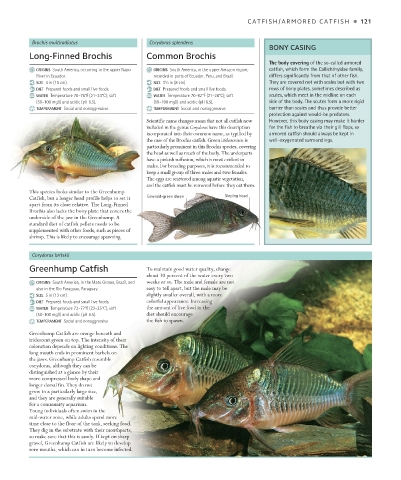
         This species looks similar to the Greenhump
         Catfish, but a longer head profile helps to set it   Emerald-green sheen  Sloping head
         apart from its close relative. The Long-Finned
         Brochis also lacks the bony plate that covers the
         underside of the jaw in the Greenhump. A
         standard diet of catfish pellets needs to be
         supplemented with other foods, such as pieces of
         shrimp. This is likely to encourage spawning.

          Corydoras britskii
         Greenhump Catfish               To maintain good water quality, change
                                         about 30 percent of the water every two
           ORIGINS  South America, in the Mato Grosso, Brazil, and   weeks or so. The male and female are not
           also in the Rio Paraguay, Paraguay.  easy to tell apart, but the male may be
           SIZE  5 in (13 cm).           slightly smaller overall, with a more
           DIET  Prepared foods and small live foods.  colorful appearance. Increasing
           WATER  Temperature 73–77°F (23–25°C); soft    the amount of live food in the
           (50–100 mg/l) and acidic (pH 6.5).  diet should encourage
           TEMPERAMENT  Social and nonaggressive.  the fish to spawn.
         Greenhump Catfish are orange beneath and
         iridescent green on top. The intensity of their
         coloration depends on lighting conditions. The
         long mouth ends in prominent barbels on
         the jaws. Greenhump Catfish resemble
         corydoras, although they can be
         distinguished at a glance by their
         more compressed body shape and
         longer dorsal fin. They do not
         grow to a particularly large size,
         and they are generally suitable
         for a community aquarium.
         Young individuals often swim in the
         mid-water zone, while adults spend more
         time close to the floor of the tank, seeking food.
         They dig in the substrate with their mouthparts,
         so make sure that this is sandy. If kept on sharp
         gravel, Greenhump Catfish are likely to develop
         sore mouths, which can in turn become infected.


   US_120-121_Catfish.indd   121                                                                     29/08/18   4:09 PM

