


Page 127 - Encyclopedia of Aquarium and Pond Fish, 3rd Edition
P. 127
CATFISH/CORYDORAS    125


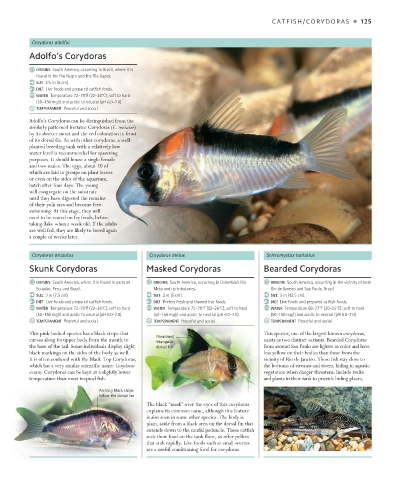
          Corydoras adolfoi
         Adolfo’s Corydoras

           ORIGINS  South America, occurring in Brazil, where it is
           found in the Rio Negro and the Rio Uapes.
           SIZE  2 ⁄2 in (6 cm).
              1
           DIET  Live foods and prepared catfish foods.
           WATER  Temperature 72–79°F (22–26°C); soft to hard
           (50–150 mg/l) and acidic to neutral (pH 6.0–7.0).
           TEMPERAMENT  Peaceful and social.
         Adolfo’s Corydoras can be distinguished from the
         similarly patterned Imitator Corydoras (C. imitator)
         by its shorter snout and the red coloration in front
         of its dorsal fin. As with other corydoras, a well-
         planted breeding tank with a relatively low
         water level is recommended for spawning
         purposes. It should house a single female
         and two males. The eggs, about 30 of
         which are laid in groups on plant leaves
         or even on the sides of the aquarium,
         hatch after four days. The young
         will congregate on the substrate
         until they have digested the remains
         of their yolk sacs and become free-
         swimming. At this stage, they will
         need to be reared on fry foods, before
         taking flake when a week old. If the adults
         are well fed, they are likely to breed again
         a couple of weeks later.

          Corydoras arcuatus              Corydoras metae                 Scleromystax barbatus
         Skunk Corydoras                 Masked Corydoras                 Bearded Corydoras

           ORIGINS  South America, where it is found in parts of   ORIGINS  South America, occurring in Colombia’s Rio   ORIGINS  South America, occurring in the vicinity of both
           Ecuador, Peru, and Brazil.      Meta and its tributaries.        Rio de Janeiro and Sao Paulo, Brazil.
           SIZE  3 in (7.5 cm).            SIZE  2 in (5 cm).               SIZE  5 in (12.5 cm).
           DIET  Live foods and prepared catfish foods.  DIET  Prefers fresh and thawed live foods.  DIET  Live foods and prepared catfish foods.
           WATER  Temperature 72–79°F (22–26°C); soft to hard   WATER  Temperature 72–79°F (22–26°C); soft to hard   WATER  Temperature 68–77°F (20–25°C); soft to hard
           (50–150 mg/l) and acidic to neutral (pH 6.0–7.0).  (50–150 mg/l) and acidic to neutral (pH 6.0–7.0).   (50–150 mg/l) and acidic to neutral (pH 6.0–7.0).
           TEMPERAMENT  Peaceful and social.  TEMPERAMENT  Peaceful and social.  TEMPERAMENT  Peaceful and social.
         This pink-bodied species has a black stripe that   Prominent     This species, one of the largest known corydoras,
         curves along its upper body from the mouth to    triangular      exists as two distinct variants. Bearded Corydoras
         the base of the tail. Some individuals display slight   dorsal fin  from around Sao Paulo are lighter in color and have
         black markings on the sides of the body as well.                 less yellow on their bodies than those from the
         It is often confused with the Black-Top Corydoras,               vicinity of Rio de Janeiro. These fish stay close to
         which has a very similar scientific name: Corydoras              the bottoms of streams and rivers, hiding in aquatic
         acutus. Corydoras can be kept at a slightly lower                vegetation when danger threatens. Include rocks
         temperature than most tropical fish.                             and plants in their tank to provide hiding places.

                            Arching black stripe
                            below the dorsal fin
                                         The black “mask” over the eyes of this corydoras
                                         explains its common name, although this feature
                                         is also seen in some other species. The body is
                                         plain, aside from a black area on the dorsal fin that
                                         extends down to the caudal peduncle. These catfish
                                         seek their food on the tank floor, so offer pellets
                                         that sink rapidly. Live foods such as small worms
                                         are a useful conditioning food for corydoras.


   US_124-125_Corydoras_2.indd   125                                                                 29/08/18   4:09 PM

