


Page 126 - Encyclopedia of Aquarium and Pond Fish, 3rd Edition
P. 126
124    FRESHWATER FISH DIRECTORY


          Corydoras rabauti               Corydoras haraldschultzi        Corydoras agassizii
         Rabaut’s Corydoras              Harald Schultz’s Corydoras       Agassiz’s Corydoras

           ORIGINS  South America, close to the confluence of the   ORIGINS  South America, occurring in Rio Tocantins and   ORIGINS  Western South America, where it is found in
           Rio Negro and the Amazon, near Tabatinga, Brazil.  Rio Araguaia in central Brazil.  the vicinity of Iquitos, Peru.
           SIZE  2 ⁄2 in (6 cm).           SIZE  3 in (7.5 cm).             SIZE  3 ⁄2 in (9 cm).
                                                                               1
              1
           DIET  Live foods and prepared catfish foods.  DIET  Live foods and prepared catfish foods.  DIET  Live foods and prepared catfish foods.
           WATER  Temperature 72–79°F (22–26°C); soft to hard   WATER  Temperature 75–82°F (24–28°C); soft to hard   WATER  Temperature 72–79°F (22–26°C); soft to hard
           (50–150 mg/l) and acidic to neutral (pH 6.0–7.0).  (50–150 mg/l) and acidic to neutral (pH 6.0–7.0).  (50–150 mg/l) and acidic to neutral (pH 6.0–7.0).
           TEMPERAMENT  Peaceful and social.  TEMPERAMENT  Peaceful and social.  TEMPERAMENT  Peaceful and social.
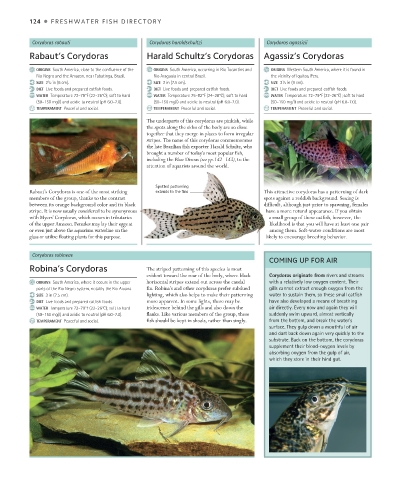
                                         The underparts of this corydoras are pinkish, while
                                         the spots along the sides of the body are so close
                                         together that they merge in places to form irregular
                                         stripes. The name of this corydoras commemorates
                                         the late Brazilian fish exporter Harald Schultz, who
                                         brought a number of today’s most popular fish,
                                         including the Blue Discus (see pp.142–143), to the
                                         attention of aquarists around the world.


                                            Spotted patterning
         Rabaut’s Corydoras is one of the most striking   extends to the fins  This attractive corydoras has a patterning of dark
         members of the group, thanks to the contrast                     spots against a reddish background. Sexing is
         between its orange background color and its black                difficult, although just prior to spawning, females
         stripe. It is now usually considered to be synonymous            have a more rotund appearance. If you obtain
         with Myers’ Corydoras, which occurs in tributaries                a small group of these catfish, however, the
         of the upper Amazon. Females may lay their eggs at                likelihood is that you will have at least one pair
         or even just above the aquarium waterline on the                  among them. Soft-water conditions are most
         glass or utilize floating plants for this purpose.               likely to encourage breeding behavior.

          Corydoras robineae
                                                                           COMING UP FOR AIR
         Robina’s Corydoras              The striped patterning of this species is most
                                         evident toward the rear of the body, where black   Corydoras originate from rivers and streams
           ORIGINS  South America, where it occurs in the upper   horizontal stripes extend out across the caudal    with a relatively low oxygen content. Their
           parts of the Rio Negro system, notably the Rio Aiuana.  fin. Robina’s and other corydoras prefer subdued   gills cannot extract enough oxygen from the
           SIZE  3 in (7.5 cm).          lighting, which also helps to make their patterning   water to sustain them, so these small catfish
           DIET  Live foods and prepared catfish foods.  more apparent. In some lights, there may be   have also developed a means of breathing
           WATER  Temperature 72–79°F (22–26°C); soft to hard   iridescence behind the gills and also down the   air directly. Every now and again they will
           (50–150 mg/l) and acidic to neutral (pH 6.0–7.0).  flanks. Like various members of the group, these   suddenly swim upward, almost vertically
           TEMPERAMENT  Peaceful and social.  fish should be kept in shoals, rather than singly.  from the bottom, and break the water’s
                                                                           surface. They gulp down a mouthful of air
                                                                           and dart back down again very quickly to the
                                                                           substrate. Back on the bottom, the corydoras
                                                                           supplement their blood-oxygen levels by
                                                                           absorbing oxygen from the gulp of air,
                                                                           which they store in their hind gut.


   US_124-125_Corydoras_2.indd   124                                                                 29/08/18   4:09 PM

