


Page 141 - Encyclopedia of Aquarium and Pond Fish, 3rd Edition
P. 141
CICHLIDS    139


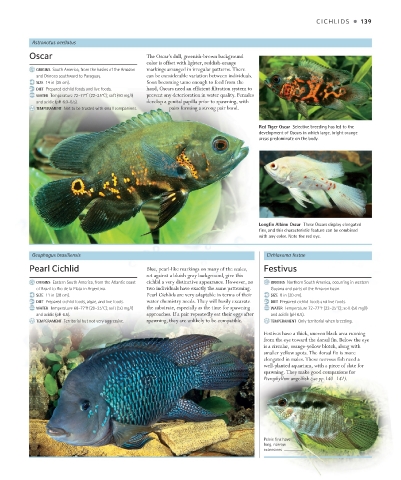
          Astronotus ocellatus
         Oscar                           The Oscar’s dull, greenish-brown background
                                         color is offset with lighter, reddish-orange
           ORIGINS  South America, from the basins of the Amazon   markings arranged in irregular patterns. There
           and Orinoco southward to Paraguay.   can be considerable variation between individuals.
           SIZE  14 in (35 cm).          Soon becoming tame enough to feed from the
           DIET  Prepared cichlid foods and live foods.   hand, Oscars need an efficient filtration system to
           WATER  Temperature 72–77°F (22–25°C); soft (50 mg/l)   prevent any deterioration in water quality. Females
           and acidic (pH 6.0–6.5).      develop a genital papilla prior to spawning, with
           TEMPERAMENT  Not to be trusted with small companions.  pairs forming a strong pair bond.

                                                                        Red Tiger Oscar  Selective breeding has led to the
                                                                        development of Oscars in which large, bright orange
                                                                        areas predominate on the body.


                                                                        Longfin Albino Oscar  These Oscars display elongated
                                                                        fins, and this characteristic feature can be combined
                                                                        with any color. Note the red eye.

          Geophagus brasiliensis                                          Cichlasoma festae
         Pearl Cichlid                   Blue, pearl-like markings on many of the scales,   Festivus
                                         set against a bluish-gray background, give this
           ORIGINS  Eastern South America, from the Atlantic coast   cichlid a very distinctive appearance. However, no   ORIGINS  Northern South America, occurring in western
           of Brazil to Rio de la Plata in Argentina.  two individuals have exactly the same patterning.   Guyana and parts of the Amazon basin.
           SIZE  11 in (28 cm).          Pearl Cichlids are very adaptable in terms of their   SIZE  8 in (20 cm).
           DIET  Prepared cichlid foods, algae, and live foods.   water chemistry needs. They will busily excavate   DIET  Prepared cichlid foods and live foods.
           WATER  Temperature 68–77°F (20–25°C); soft (50 mg/l)   the substrate, especially as the time for spawning   WATER  Temperature 72–77°F (22–25°C); soft (50 mg/l)
           and acidic (pH 6.5).          approaches. If a pair repeatedly eat their eggs after   and acidic (pH 6.5).
           TEMPERAMENT  Territorial but not very aggressive.  spawning, they are unlikely to be compatible.  TEMPERAMENT  Only territorial when breeding.
                                                                          Festivus have a thick, uneven black area running
                                                                          from the eye toward the dorsal fin. Below the eye
                                                                          is a circular, orange-yellow blotch, along with
                                                                          smaller yellow spots. The dorsal fin is more
                                                                          elongated in males. These nervous fish need a
                                                                          well-planted aquarium, with a piece of slate for
                                                                          spawning. They make good companions for
                                                                          Pterophyllum angelfish (see pp.140–141).


                                                                          Pelvic fins have
                                                                          long, narrow
                                                                          extensions


   US_138-139_Cichlids_2.indd   139                                                                  29/08/18   4:09 PM

