


Page 143 - Encyclopedia of Aquarium and Pond Fish, 3rd Edition
P. 143
CICHLIDS/ANGELFISH    141


                                          Pterophyllum altum

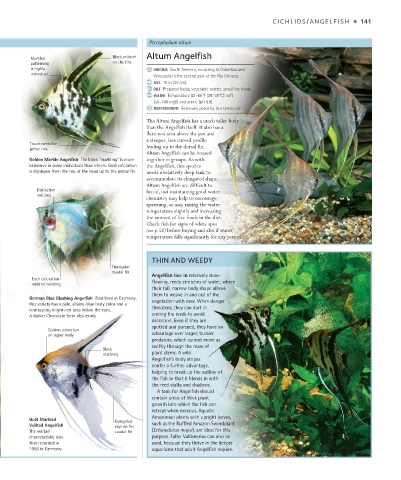
         Marbled                Black evident   Altum Angelfish
         patterning             on the fins
         is highly                         ORIGINS  South America, occurring in Colombia and
         individual                        Venezuela in the central part of the Rio Orinoco.
                                           SIZE  10 in (25 cm).
                                           DIET  Prepared foods, vegetable matter, small live foods.
                                           WATER  Temperature 82–86°F (28–30°C); soft
                                           (50–100 mg/l) and acidic (pH 6.0).
                                           TEMPERAMENT  Relatively peaceful, but territorial.
                                         The Altum Angelfish has a much taller body
                                         than the Angelfish itself. It also has a
                                         flattened area above the jaw and
                                         a steeper, less curved profile
         Touch-sensitive
         pelvic fins                     leading up to the dorsal fin.
                                         Altum Angelfish can be housed
         Golden Marble Angelfish  The black “marbling” is more   together in groups. As with
         extensive in some individuals than others. Gold coloration   the Angelfish, this species
         is displayed from the top of the head up to the dorsal fin.  needs a relatively deep tank to
                                         accommodate its elongated shape.
                                         Altum Angelfish are difficult to
           Distinctive                   breed, but maintaining good water
           red area
                                         chemistry may help to encourage
                                         spawning, as may raising the water
                                         temperature slightly and increasing
                                         the amount of live foods in the diet.
                                         Check fish for signs of white spot
                                         (see p.58) before buying and also if water
                                         temperature falls significantly for any period.

                                           THIN AND WEEDY
                                Triangular
                                caudal fin
          Even coloration                  Angelfish live in relatively slow-
          with no banding                  flowing, reedy stretches of water, where
                                           their tall, narrow body shape allows
                                           them to weave in and out of the
         German Blue Blushing Angelfish  First bred in Germany,
         this variety has a pale, silvery-blue body color and a   vegetation with ease. When danger
         contrasting bright-red area below the eyes.   threatens, they can dart in
         A darker Chocolate form also exists.  among the reeds to avoid
                                           detection. Even if they are
                                           spotted and pursued, they have an
              Golden coloration
              on upper body                advantage over larger, bulkier
                                           predators, which cannot move as
                                           swiftly through the mass of
                             Black
                             marbling      plant stems. A wild
                                           Angelfish’s body stripes
                                           confer a further advantage,
                                           helping to break up the outline of
                                           the fish so that it blends in with
                                           the reed stalks and shadows.
                                             A tank for Angelfish should
                                           contain areas of thick plant
                                           growth into which the fish can
                                           retreat when nervous. Aquatic
         Gold Marbled            Elongated   Amazonian plants with upright leaves,
         Veiltail Angelfish      rays on the   such as the Ruffled Amazon Swordplant
         The veiltail            caudal fin  (Echinodorus major), are ideal for this
         characteristic was                purpose. Taller Vallisnerias can also be
         first recorded in                 used, because they thrive in the deeper
         1956 in Germany.                  aquariums that adult Angelfish require.


   US_140-141_Angelfish.indd   141                                                                   29/08/18   4:09 PM

